
From the time of Caesar, and likely before, politics has been a family affair. It is quite likely that you vote for candidates from the same political party as your parents. Decade after decade, families have voted Republican or Democrat, depending on how their parents had voted and their parents before them.
But America’s melting pot culture brings about changes. This occurred in my own family. My father, James Chester O’Leary, was a staunch Democrat, a descendant of Irish Catholics from Rhode Island. My mother, Martha Hathaway Whitaker, was a descendant of New England’s aristocracy. She was rightly proud of her seventh great-grandfather, William Bradford, one of the founders of the Pilgrim bastion at Plymouth Rock and its first governor. Her family consistently voted Republican.

On left, circa 1918 with the author’s mother. On right, circa 1942.
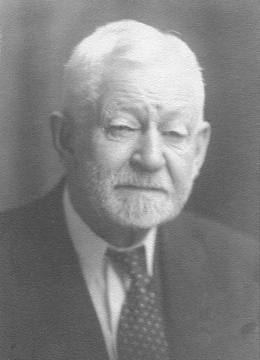
My parents married in 1937 and lived in Norton, Massachusetts, with my mother’s grandfather, Milo Rockwood Whitaker. Born in 1857, Milo was an old man and needed caregivers. By all accounts, Milo was delightful and revered by his neighbors, children, and grandchildren. He died in 1946, the year before my birth, so I never had the good fortune to know him. But we have many pictures of him; as you can see, he was a good-looking, seemingly kind-hearted man. He was notoriously Republican, a party formed just three years before Milo’s birth. (Before becoming Republicans, the Whitakers likely were members of the Whig party.) Practical, conservative, and fiscally responsible, that defines the Whitakers of the late 19th century and throughout most of the 20th century as well.

In 1944, Franklin Delano Roosevelt was running for an unprecedented fourth term as president of the United States. Roosevelt had led the nation out of the Great Depression and was now leading it in the fight against fascism in World War II. There was a definite sense of “don’t rock the boat.” However, most of the country also felt that Roosevelt had done well. Roosevelt is the first president for whom we have archival popularity polls, and his rating was an astonishing 70% just before World War II. That level of national support doesn’t come from just one party. Roosevelt had earned the respect of Democrats and Republicans, including Milo.
According to accounts, my father and Milo would often engage in political talk, and my father knew that my great-grandfather admired Roosevelt and his leadership. So, in 1944, as Roosevelt campaigned against Thomas Dewey, my father asked Milo if he would vote for Franklin Delano Roosevelt. Milo thought for a moment and then said, “Chet, if God was running as a Democrat and the devil as a Republican, I’d have to vote for the devil.”
My father told the story countless times during my youth, and I suppose it’s not surprising that I would remember it in this extraordinary election of 2024. It seems to me we have many Milos in this country—individuals who have voted Republican all of their lives and now are compelled to vote for the devil. What else could possibly explain the enduring allegiance that some people obviously have towards Donald J. Trump?
But is it allegiance to Trump or the Grand Old Party? I suspect it is the latter. I read once that loyalty to Trump was like loyalty to a constantly losing baseball team. There is no rhyme or reason, only loyalty, and loyalty is usually an admirable trait. But loyalty can also be perverted, twisted, and tormented into a shape that barely resembles what it once was. Today’s GOP would be unrecognizable to Milo. It is scarcely recognizable to some present-day members. Some, like Liz Cheney and John Kelly, have bravely broken rank and are attempting to rally their fellow members to vote Democrat. As the Republican former Lt. Governor of Georgia said at the Democratic convention, voting for Harris doesn’t make you a Democrat; it makes you a “Patriot.”
If Milo were alive today, I like to think he would agree and would be preparing to cast his first vote for a Democrat, perhaps with trembling hands but with the clear understanding that his beloved political party has been the victim of a hostile takeover. It has devolved into a cult, a dangerous vehicle for a deranged man.
But, sadly, I can’t be sure of that because there are so many people who still seem bent on electing America’s first fascist dictator.
Yes. It is that serious.
So, to those who are preparing to cast their vote for a convicted felon who has broken every one of the Ten Commandments, I issue a plea: don’t be a Milo. Do not vote for the devil. ❧



 Alice's WanderLand