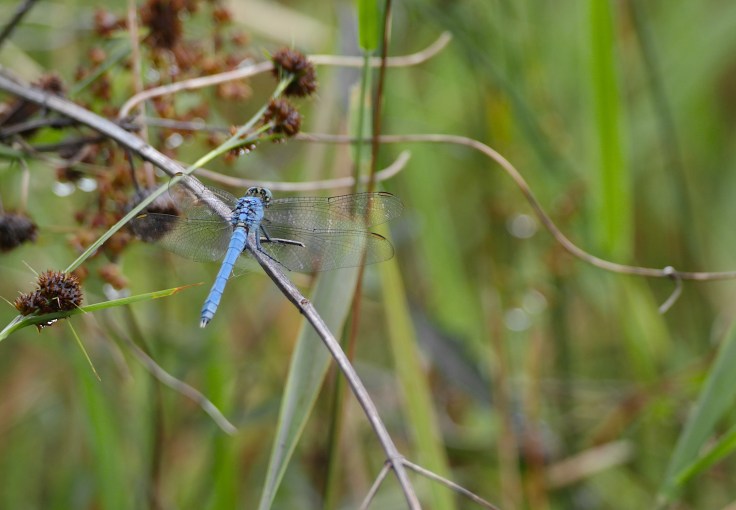
A Dragonfly ponders its next move, perched on a tree branch. The complexity of this creature is overwhelming to me: four separate wings that are so sheer you can see through them and a “head” that is mostly eyes and those eyes, so I am told, do not see the world as we do. Consider this paragraph from New Scientist:
We humans have what’s known as tri-chromatic vision, which means we see colours as a combination of red, blue and green. This is thanks to three different types of light-sensitive proteins in our eyes, called opsins. We are not alone: di-, tri- and tetra-chromatic vision is de rigueur in the animal world, from mammals to birds and insects.
Enter the dragonfly. A study of 12 dragonfly species has found that each one has no fewer than 11, and some a whopping 30, different visual opsins.
The dragonfly’s world is a multi-color, psychedelic landscape that is, of course, perfectly normal to the dragonfly. How dull our world would be to this marvelous being. ❦
Can you believe this provocative and somewhat off-putting image is an orchid? To me it looks like an escapee from a set of Aliens but is actually a Coryanthes orchid. It is otherwise known as a Bucket Orchid and the second view may explain why.
Unlike a Venus Flytrap which lures insects to their deaths (thus feeding the plant) the Coryanthes uses insects to pollinate. There are many kinds of Coryanthes orchids and my friend Bob, who has raised this orchid, has this one labeled Coryanthes macrantha. Macrantha means “large flower” and that is certainly apt for this orchid which looks, to me, like a hanging slab of meat.
Is that part of the allure, the pretense of being a slab of meat? I guess we’d need to ask the Stink Bugs and other flying insects that hovered around it. They, alas, are not talking. ❧
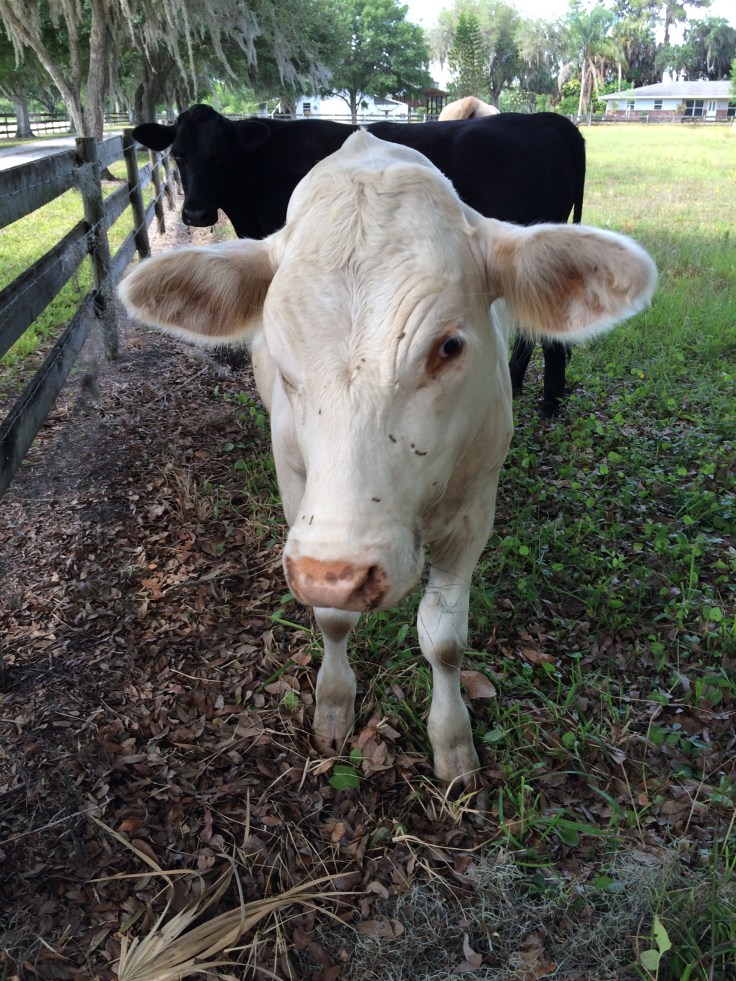
It has been almost four months since I first posted a picture of the nearby family of cows. The calves have grown and this young one is looking very coy these days. ❧
At this time of year the sunsets become long and beautiful. Often the birds will seem to spring from the earth in celebration, dancing together on the ethers, soaring high into the fading light. How I envy them. ❧
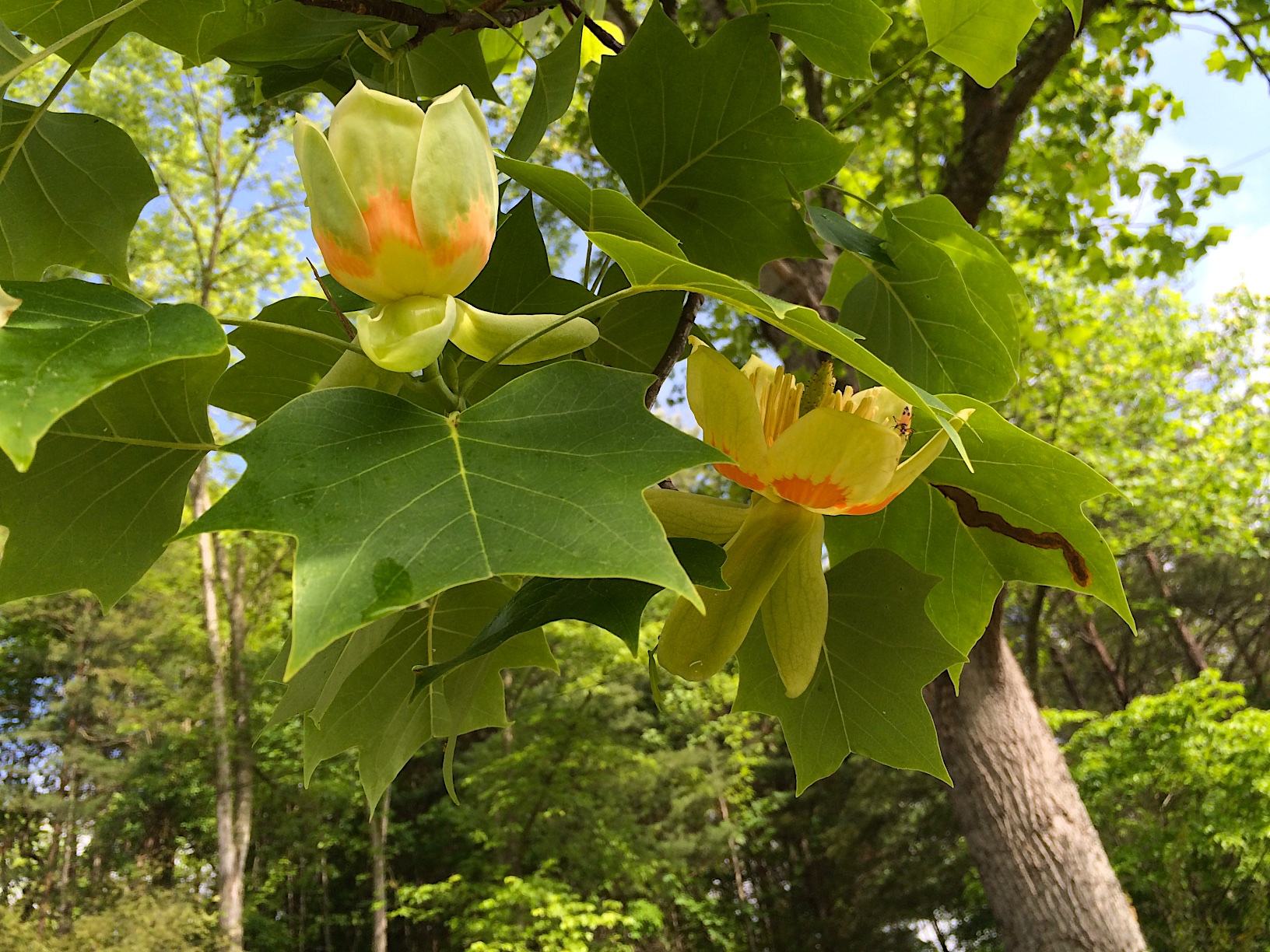
Discoveries are common place on Fawn Hill. I had always assumed the tall trees along the driveway were poplars but this year I have the good fortune to be here as they bloom and, as you can see, the blooms are lovely. I thought they must be tulip poplars which they are but now I have learned they are not poplars at all.
Liriodendron tulipifera, the tulip tree, is actually a member of the magnolia family and these two are prime specimens. Our friends at Wikipedia have once again provided a wealth of information. I was relieved to learn they are not poplars which seem to have a nasty habit of becoming very tall and then rotting out from the inside.
But these are tulip trees and are prized lumber. They were used by the Indians for dugout canoes and its lumber has been called Canoewood. According to Wikipedia it is one “of the largest and most valuable hardwoods of eastern North America.” It can grow to a height of 190 feet! Ours would seem to be about 60 feet. The average size is around 70 feet. The birds enjoy their seeds and humans can fall in love with their blossoms. ❧
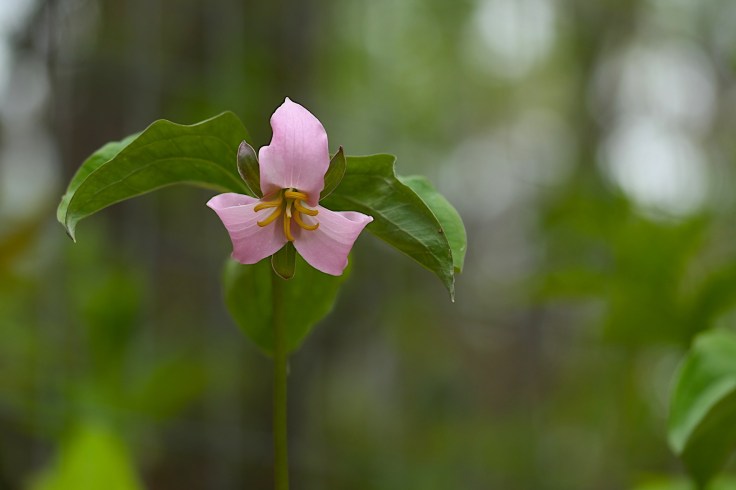
Trillium are part of the lily order but have their own family. And that is no surprise because, as it happens, there are many different varieties that grow across the globe. I was unfamiliar with it until we acquired the Fawn Hill property. On our little strand of land we have dozens of pink trillium which, officially speaking, are Trillium catesbaei, or Catesby trillium. There are quite a few more this year than I remember from the past two seasons that we have enjoyed this place. Whether that is due to our clearing of overgrowth or perfect growing conditions I don’t know.
As a member of the lily order they grow from rhizomes. This is great news since propagation will take care of itself. In the picture below you can count at least seven in a relatively small patch of land. Most of ours are pink although there are some white and one or two purple varities.
They are cheery beings and welcome on Fawn Hill. ✦
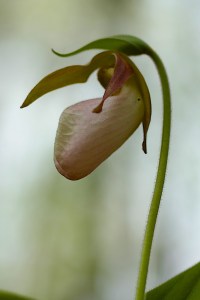
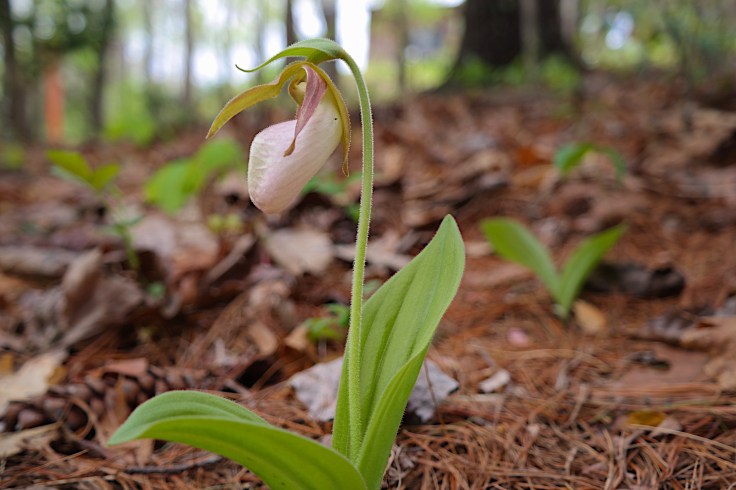
When I was a child growing up in Massachusetts, there seemed no shortage of Lady Slippers; that delicate wild orchid that is at once beautifully dainty and profoundly evocative. They are of the subfamily Cypripedioideae and grace most of the continents. According to Wikipedia:
The subfamily Cypripedioideae is monophyletic and consists of five genera. The Cypripedium genus is found across much of North America, as well as in parts of Europe and Asia. The state flower of Minnesota is the showy lady’s slipper (Cypripedium reginae). The pink lady’s slipper is also the official provincial flower of the Canadian province of Prince Edward Island.
My sister and I recall them differently. She recalls them being in the woods behind her friend’s house and I recall them being in the woods behind our house, the distinction being that we moved to a big house that had acres of woods behind it just before my sister went off to boarding school. I remember ripping them from the ground and bringing them home to my mother. She rarely scolded us but she did suggest, in that way she had, that I simply leave them be. After we moved to Florida, when I was 12-years old I rarely saw a Lady Slipper again. I had heard (incorrectly) that they were endangered. So, you can imagine my delight when I discovered two(!) Lady Slippers on the hillside at Fawn Hill in North Carolina.
Lady Slipper (Cypripedium acaule) on the hillside at Fawn Hill.
This will be our third summer at Fawn Hill and every year brings more surprises. In a few days we are having some trees removed, weed trees mainly, opportunists that have grabbed at a chance to thrive, ironically in the absence of care. As we clear away more and more of this over-growth we uncover a plan. The woman who first owned this land and lived here for more than a decade was a gardener and she installed some beautiful plantings. Daffodils and tulips have popped up, peonies seem abundant, and azalea bushes are emerging from what tried, very hard, to become forest. What will surprise us when the weed trees are gone and more light reaches the bank of land behind the house? Stay tuned. ✦
It has been a crazy time for weather. Friends in the Northeast continue to be hammered by snow and ice. In Australia they had not just one but TWO(!) major hurricanes (or cyclones) hitting the country at the same time. One, Cyclone Marcia, was a Category 5!
Here in Central Florida we had freezing temperatures for one night but today, just two days later, it was in the low 80s and this picture, snapped at Myakka Park this afternoon, looks very much like summer time.
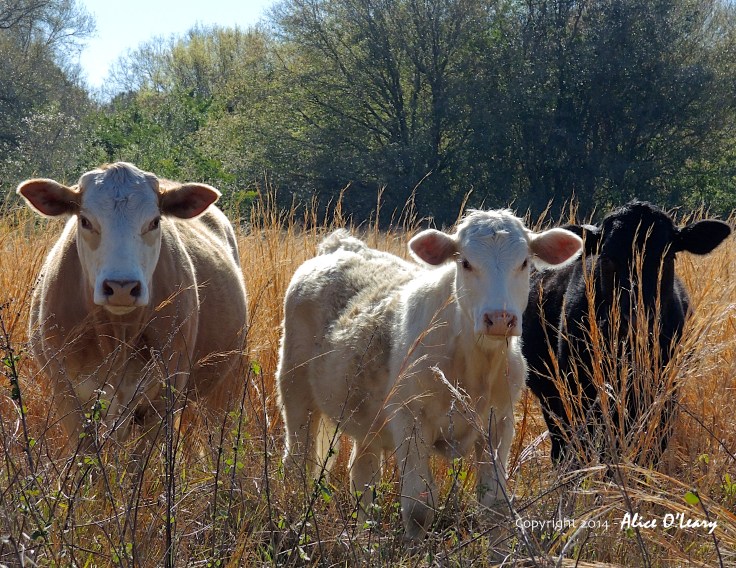
This mother cow and two calves were willing posers this morning as Tango and I took our morning walk around Wilderness Lane. It was a bright, clear morning and the sun was warming as we took time to consider each other. When I was growing up in Sarasota there were many, many cows but now it has become a city and there are fewer of these bucolic scenes. More’s the pity. ❧










 Alice's WanderLand