Image #262 – Stewards of the Land

Image #262


Having dominion over the land and sea is not an easy task and recent history will call to question whether we are doing a good job of things. As for me, I do my best to keep things in order here on my little acre on Fawn Hill. Today that included trimming dead branches and leaves from the apple trees. The late frost of last April took its toll but, fortunately, not all the fruit. This year’s bounty will be no where near last year’s but there will still be plenty. There is evidence the deer are already enjoying the fruit of my apple trees.  I’m glad.  ❧

Image #261 – A Soggy Hummingbird

Image #261


A soggy hummingbird gives me the eye during our two days of constant rain. Thankfully it was constant and not torrential but it was seriously constant and it made it tough for our friends who live in trees.  Where do they go when night falls?  Certainly some are minding nests and protecting young ones. Last night must have been a long one because the rain did not cease.  First order of business when the rain stopped? Off to Tractor Supply for more birdseed, of course.  ❧

Image #260 – Hummingbird in the rain

Ruby throat hummingbird

It has been a wet day here in Western North Carolina. Wet and cool. Natives are already predicting a long, cold winter.  But for the moment it is still summer and there are baby birds to feed.  Today my feeder was like a drive-thru at a fast-food restaurant. At one point I counted eight cardinals gathered round the feeders. Some of the males flew in to frighten the poor house finches who look so miserable in weather like this. Once the finches were gone the cardinals fed peacefully in some pre-ordained order. Who knows how all these things work.

The hummingbirds have also been in and out all day. That’s one of them in the picture. Notice the raindrop on his head. Hummingbirds rarely feed at the same time. They must have “little bird syndrome” because they are quick to drive away the other hummers. I suppose they each get enough. There were at least three today and I spent so much time observing them that I began to notice the traits and slightly different coloring.

There were at least 13 species of bird at my feeders today. It was a good day, despite the weather ❧

Image #259 – More Indian Pipes

Indian Pipe collage


My previous post (Image #258 – Indian Pipe Emerging) prompted a good friend to send me an email that said, in part,

Your image reminded me of a crocus, while some of the other images on the net looked so much like fungi I could hardly believe they were plants.  What a wonderful world this is, filled with so many remarkable and beautiful things for those who have eyes to see.  Getting the big picture is important, but you will never get the big picture if you don’t also study the small things.
Indian Pipes can really teach us a thing or two about the small stuff and also the well worn adage, you can’t judge a book by its cover. For example, it is easy to look at these remarkable structures and assume they are a variation of a mushroom but they are, in fact, a plant. The U.S. Dept. of Agriculture classifies it as a wildflower and their website provides pictures of the actual bloom, something I have set my sights on obtaining.  I was aware that the Indian Pipe has a source of nectar. The honey bee in the upper right corner of the collage keyed me in to that fact last summer.  The bee, by the way, is making a return appearance here in Alice’s Wanderland. He was originally featured in Image #52.

Indian Pipes are sometimes called “Ghost” or “Corpse” plant because of its remarkable lack of color or, more accurately, chlorophyll.  According to Wikipedia:

Instead of generating energy from sunlight, it is parasitic, more specifically a myco-heterotroph. Its hosts are certain fungi that are mycorrhizal with trees, meaning it ultimately gets its energy from photosynthetic trees. Since it is not dependent on sunlight to grow, it can grow in very dark environments as in the understory of dense forest. It is often associated with beech trees. The complex relationship that allows this plant to grow also makes propagation difficult.
The plants are rare which makes our growth here on Fawn Hill a true bonanza. They are popping up all over the hill and their presence makes me re-think efforts to clear certain areas of overgrowth and debris. One person’s debris is a plant’s lifeline.  We’ll do all that we can to preserve these lovely creatures.  What a wonderful world indeed. ❧

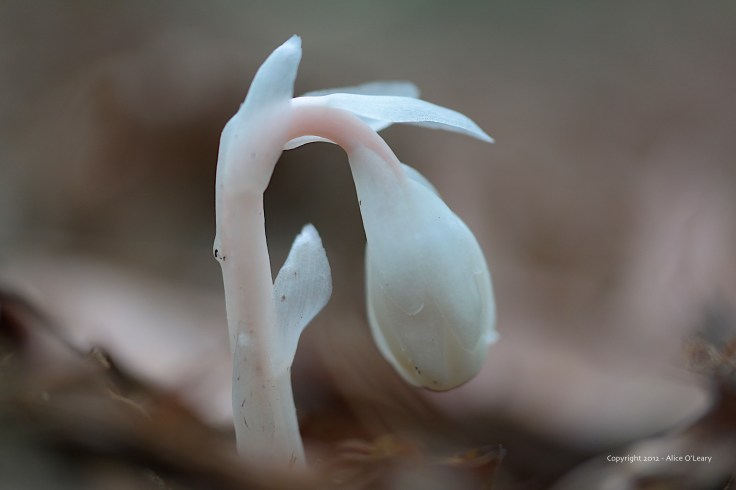
Image #258 – Indian Pipe Emerging

Indian Pipe (Monotropa uniflora)

A delicate Indian Pipe emerges in the forest. There are so many “little things” on the forest floor these days. Yesterday I shared a broken bird’s egg and today this small Indian Pipe. Stay tuned for more tiny things from the forest floor. ❧

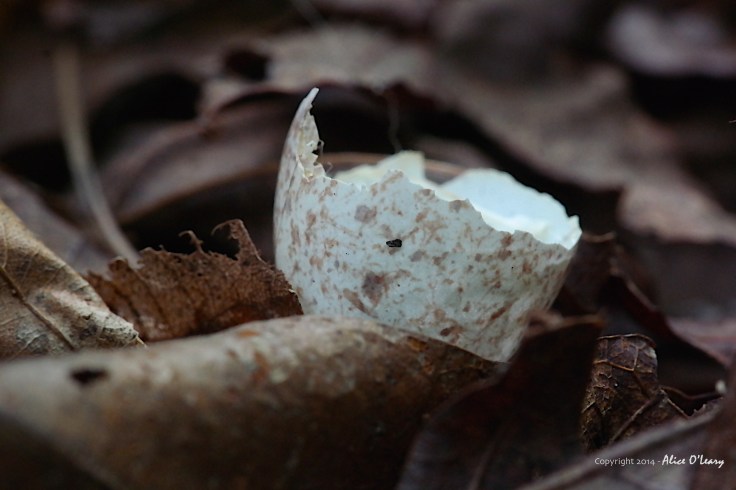
Image #257 – You Gotta Break Some Eggs to Get Baby Birds

Image #257

A successful birthing?  It would seem that way. The small remains of a bird’s egg graces the forest floor. Live long! Prosper! ❧

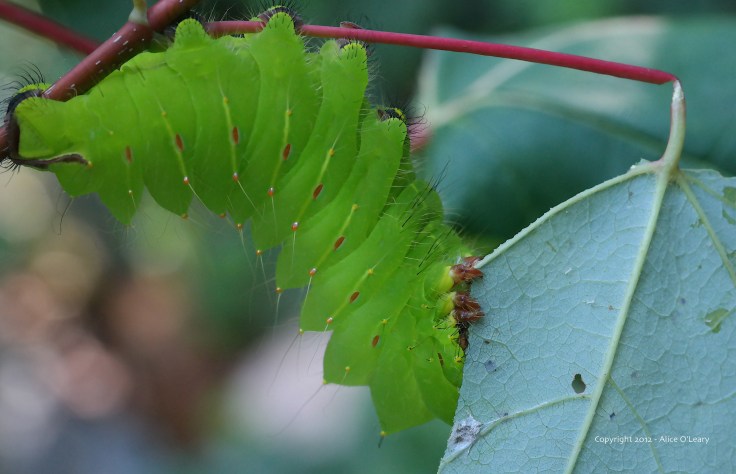
Image #255 – Summertime and life is good!


Mature larva of the Polyphemus moth


Summertime is in full swing here in the Northern Hemisphere. There is bounty everywhere. This particular caterpillar was enjoying the leaves on a sugar maple. All the books say it is among the “most common” caterpillars and this fellow was not hard to find, munching away just a few feet from the front door of the house. It will morph into the Polyphemus Moth with a wingspan of up to 6 inches. Amazing. ❧

Image #254 – Indigo Bunting


Indigo Bunting (Passerina cyanea)

An Indigo Bunting, adult male. I can’t recall sighting an Indigo Bunting before this season. A friend has told me she saw one in Manatee County but I can’t recall ever seeing one before.   So, this is an extra special event. I apologize for the graininess of the image. (SPOILER: Geek talk ahead.)  I had boosted the ISO rather high in an attempt to capture images of fireflies. In my excitement I forgot to check all the camera settings. But on some levels I like this shot being grainy.  It seems more real.

At any rate, I have now identified an Indgo Bunting at the feeder which brings the “life list” for the feeder to about 20 birds…20 and hoping.  ❧

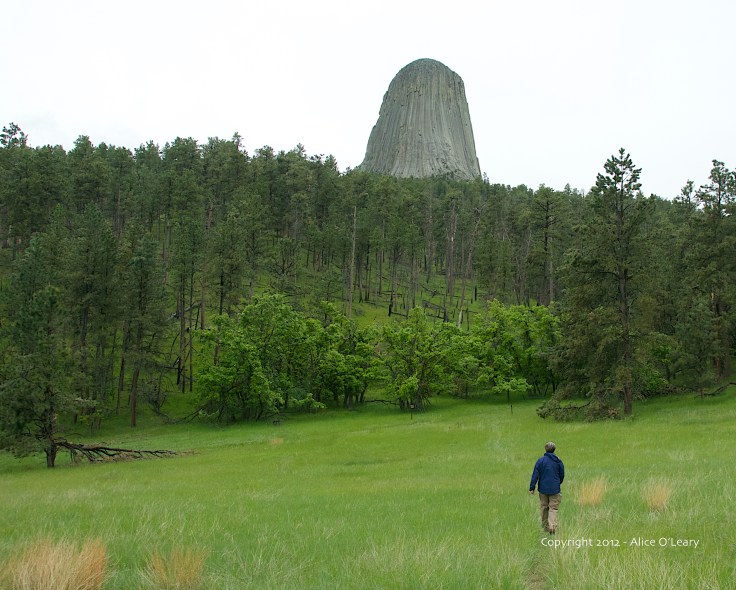
Image #253 – Devil’s Tower

Devil's Tower, Wyoming
Devil’s Tower, Wyoming


One month ago I was at Devil’s Tower in Wyoming. Made famous by the movie “Close Encounters of the Third Kind,” the rock is massively beautiful.

Our weather was not the best. It was a white-gray sky that occasionally opened up with torrents of rain.  Not exactly the best day for photography but it didn’t matter.  Devil’s Tower is such a wonder of nature. The Native Americans call it Bear Rock and legend has it the striations in the rock were caused by gigantic bear that tried to claw his way to the top after the earth spewed forth the rock to save several children (some legends claim it was three girls, another claims it was two boys). The rock literally rose from the ground after the children prayed to be saved from the massive grizzly that was chasing them.

I like thinking of it as Bear Rock. I spent some time looking at websites about the rock and one website said this, “Of course, Devil’s Tower is a white man’s name. We have no devil in our beliefs and got along well all these many centuries without him. You people invented the devil and, as far as I’m concerned, you can keep him.”   You can read more here.

Bear Rock or Devil’s Tower, it is something to behold.  We enjoyed a nice hike in the region surrounding the rock. Needless to say, it dominates the landscape (it is visible for miles, truly) and it was a constant backdrop for our hike on Joyner Trail.

Mary hiking the Joyner Trail.


Blog at WordPress.com.

Up ↑