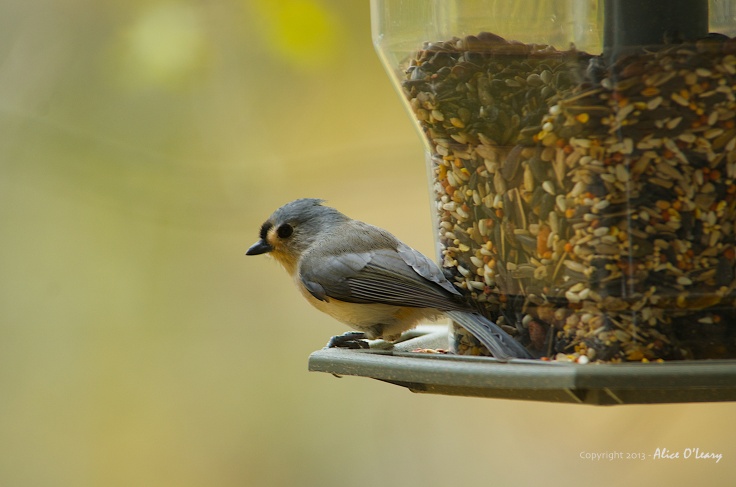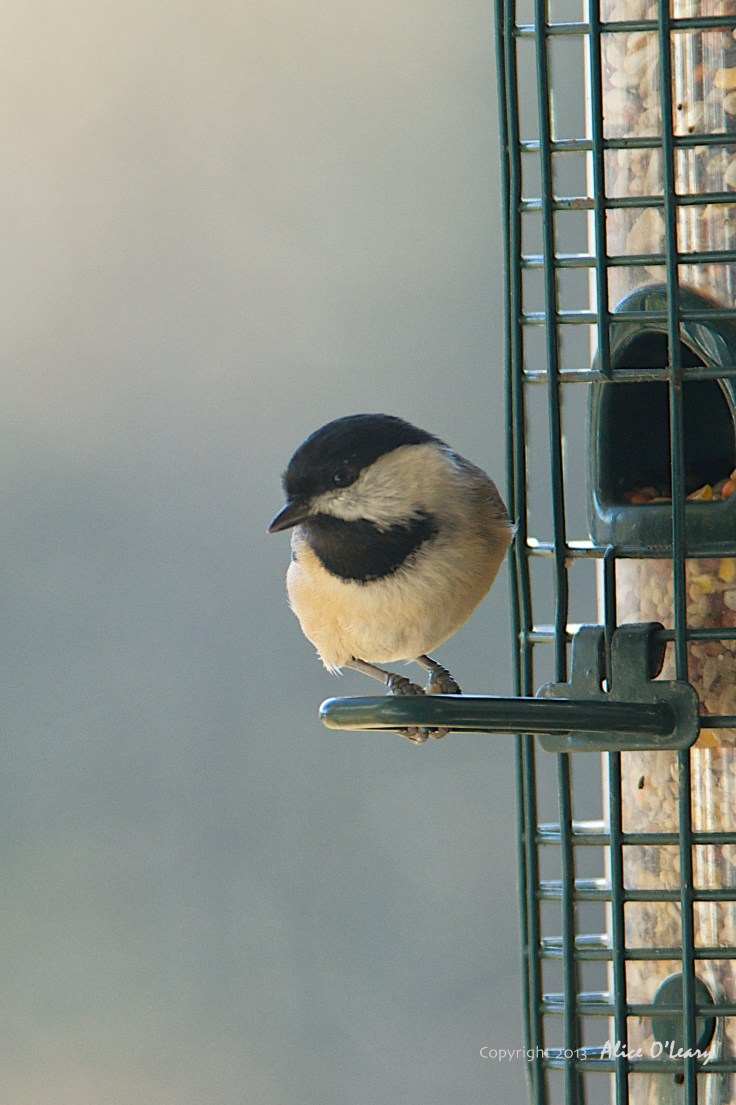
A sweet Carolina Chickadee at my feeder. Carolina Chickadees are a bit smaller than the more common Black-capped Chickadee. They are part of the same family as the titmouse, which might explain why they “hang” together. The two seem in constant company with one another. They constitute Paridae, a large family of small passerine birds, which you can learn more about by clicking on the links. They do not migrate south which means my feeders will continue to enjoy their presence throughout the winter. And that will be just fine with me. ❧
Image #142 – Intricacies
In Western North Carolina the leaves are peaking, in many areas they are already past. I have visited this region several times during autumn and, without doubt, the colors are stunning. But now I live here and the eye, like a microscope, always rachets down one or two stops, looking for the intricacies, wanting to know more about the total picture. So today, a truly glorious day in WNC, I set out from my front door and quickly found the impetus of these thoughts. It is everywhere around me–the intricacies of life, the turning of the seasons. This maple leaf tells the tale–red, green, brown; cobwebs, mimicking the fabric of space, and insect-produced black holes, portending a deeper being; the red portion looking like a Google map of a subdivision, any subdivision; the brown giving promise to its ultimate future. “Everything is on its way to somewhere else,” George Malley. ❧
Image #140 – Tufted titmouse
These guys are such frequent flyers at my birdfeeders. My Audubon Field Guide states the titmouse “are social birds and, especially in winter, join with small mixed flocks of chickadees, nuthatchers, kinglets, creeper, and the smaller woodpeckers.” Well, spot on Audubon! ! That perfectly describes my feeders just now. Mix in purple finches and cardinals and you have the Fawn Hill bird mix of the moment. I’ve been told that juncos will arrive but I remember in Washington, D.C. that the juncos arrived only when it was truly cold to the north. Perhaps the same is true here. ☙
Image #139 – Carnival Candy Slime
Like Halloween caviar, the Carnival Candy Slime fungi brightens the base of a rotting tree in Joyce Kilmer Memorial Forest. Carnival Candy Slime!!! Where do these mushroom specialists come up with these names?? Its Latin name is Arcyria denudata. I may not have it correctly identified and encourage any slime lovers out there to set me straight if I have the name wrong. A truly spectacular growth, whatever its name might be. ☙
Image #135 -The Great Smokeys
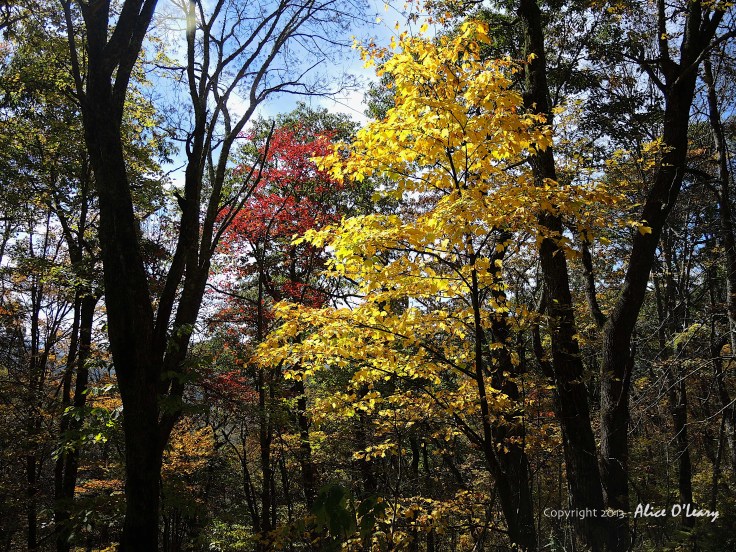
It is definitely fall here in western North Carolina. The past few nights have brought frost and the arctic blast that is chilling bones in the midwest is on its way to our little corner of the world. This photo was taken two weeks ago up on the Blue Ridge Parkway. No doubt it has already changed significantly. Leaves are falling all around reminding us of the impermanence of life but also its renewal. They lay thick on the forest floor, making a rich mulch for the life that lays beneath the surface, waiting for the light to make its winter passage and return again in the spring. ☙
Image #125 – Tango on the Log series, cont.
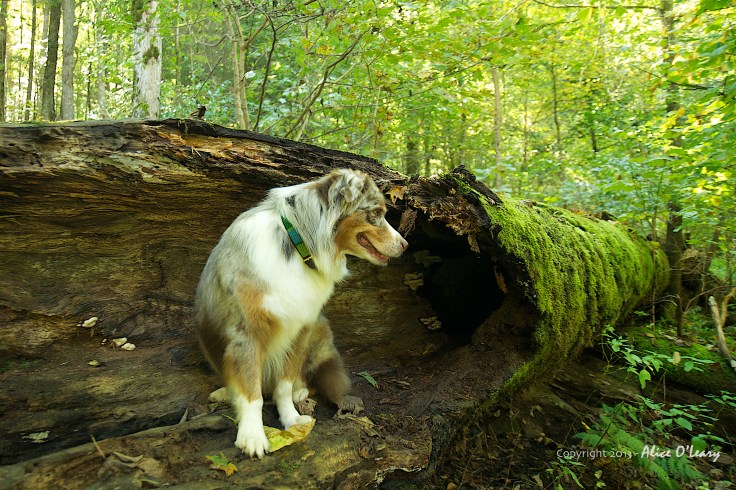
Tango on the Log — a continuing and fun theme from previous posts. This time in Joyce Kilmer Memorial Forest. Note the beautiful new collar from The Kenyan Collection, courtesy of friends Daryl & Craig. ☙
Image #124 – From Little Helmets to Shaggy Manes
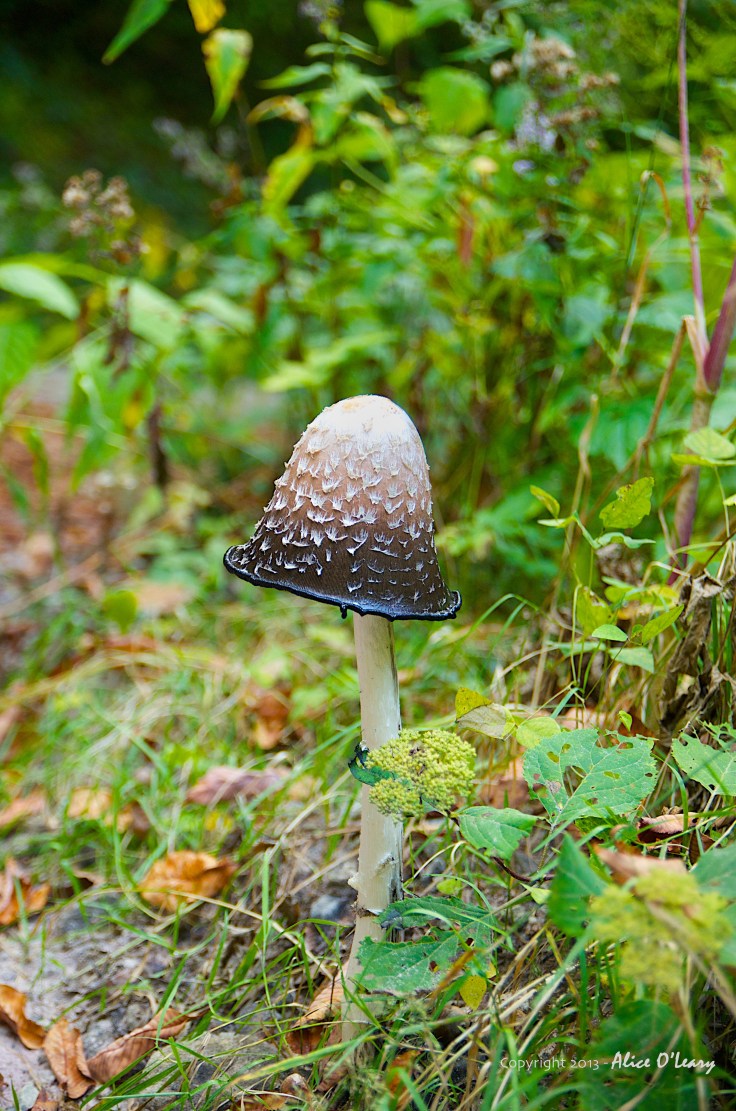
Reportedly it has been a bumper-crop-year for mushrooms in western North Carolina. Lucky me! A few days ago I posted Little Helmets, lovely white fungi that are about 2cm in height (about 3/4″). Today I present a 20+cm beauty, a Shaggy Mane (Coprinus comatus) discovered along the road to Wayah Bald. Remarkably these two mushrooms are in the same family (Inky Cap or Coprinus)! But they certainly present differently. The Little Helmets were all clustered together near a woodpile. The Shaggy Mane stood in solitary splendor at a hairpin curve on Wyaha Bald Road. ☙