Image #203 – Wild Blueberries

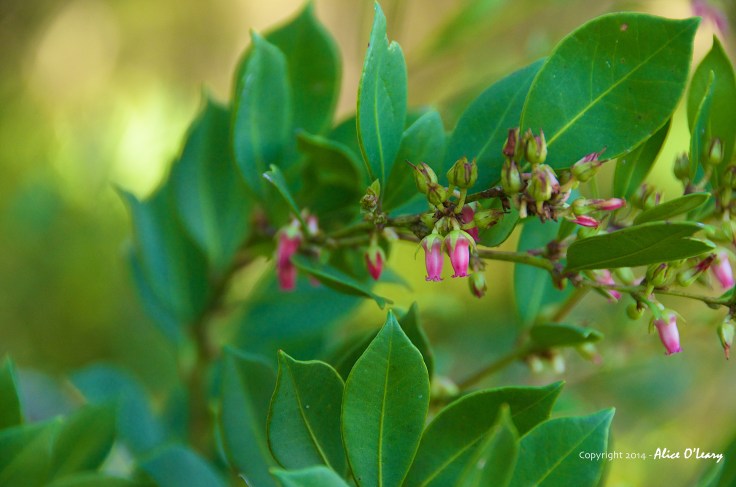
Wild Blueberry blossoms

Tango and I got out to Myakka River State Park yesterday and had an excellent hike along Fox’s Low Road.  Spring is definitely springing here in Florida. The oak trees have that lovely spring green color, wild flowers can be found and, as you can see from the photo, the blueberries have started to produce their fruit.  From blossom to fruit is about 4-6 weeks, so these bushes will be ready to feed the birds when it is time to fly back north. What a marvel nature is. ❧

Image #198 – The snow is coming, the snow is coming

Northern Cardinal (Cardinalis cardinals)

I never tire of these guys (and gals). Cardinals are a special bird.  “Winter’s flowers,” as one friend said. They have so brightened my days. This particular fellow was digitally captured during our recent snow storm. Another is forecast for this week…8-12″ are predicted.  I hope to be far away by then. I am throwing in the towel and fleeing to Florida for a few weeks. There is plenty I can do there.  If I stay here I can watch the Cardinals…which isn’t a bad thing…but life is short and it is best to make hay when the sun shines. The Florida Supreme Court has ruled and medical marijuana will be on the ballot in November 2014. I plan to do what I can to make sure that it passes. Stay tuned.  ❧

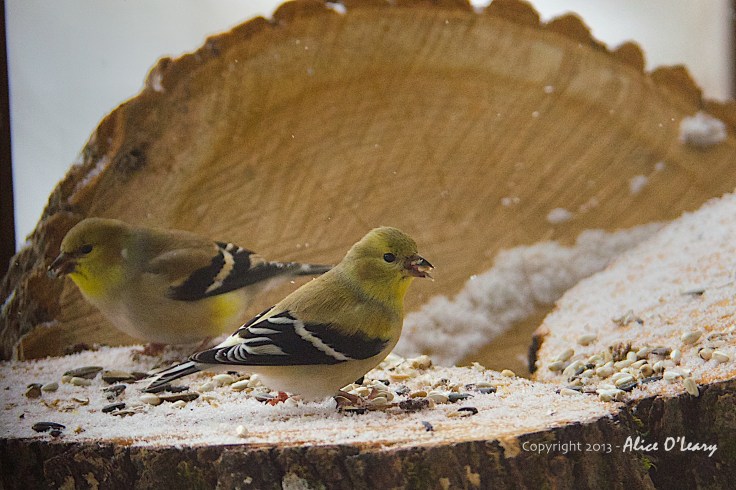
Image #197 – Goldfinches

American Goldfinches
American Goldfinch (Carduelis tristis)

More bird pictures from last week’s snow storm. These American Goldfinches are showing their spring and summer coat of bright yellow feathers…more indication that spring is on the way.  Just a few weeks ago they were so drab, almost olive green.  It is a complicated bird according to Wikipedia:

“The American Goldfinch undergoes a molt in the spring and autumn. It is the only cardueline finch to undergo a molt twice a year.[14] During the winter molt it sheds all its feathers; in the spring, it sheds all but the wing and tail feathers, which are dark brown in the female and black in the male.[13] The markings on these feathers remain through each molt, with bars on the wings and white under and at the edges of the short, notched tail.”

Surely not ALL of its feathers? Can’t say that I have seen one naked American Goldfinch and I think he/she would stand out in a crowd. 🙂

Image #196 – Eastern Towhee (Pipilo erythrophthalmus)

Eastern Towhee (Pipilo erythrophthalmus)

A good snow fall, like the one we had last week, brings many birds “out of hiding.”  The Eastern Towhee is one of those birds. Throughout the months that I have been here I would catch a glimpse of the Towhee, normally its backside, frittering about in the underbrush but rarely did I have a chance to study this beautiful bird. The snow changed all that. This fellow was grateful for the scattered seed on the porch as well as respite from the wet underbrush. I have now learned that Towhees are part of the sparrow family and it is wide-spread throughout North America. And apparently I am not alone in my inability to study this bird. According to Wikipedia, “The taxonomy of the towhees has been under debate in recent decades, and formerly this bird and the Spotted Towhee were considered a single species, the Rufous-sided Towhee.”  ❧

Blog at WordPress.com.

Up ↑