Image #152 – Opportunity!

On Friday we had some tree removal work done at Fawn Hill. There were two really bad problems–an 80 foot Poplar that was rotted at the base and hollow for about six feet up, and some limbs on a Black Oak that had died and were hanging precipitously over the house.  One piece of the Oak had already broken lose and, like a spear, pierced the roof.

The crew was here early and it was a good thing because by midday the rains had come in and the crew headed out, leaving massive quantities of lumber staged in my backyard and driveway, Image 152(1)awaiting the chipper that may arrive on Monday, weather permitting.
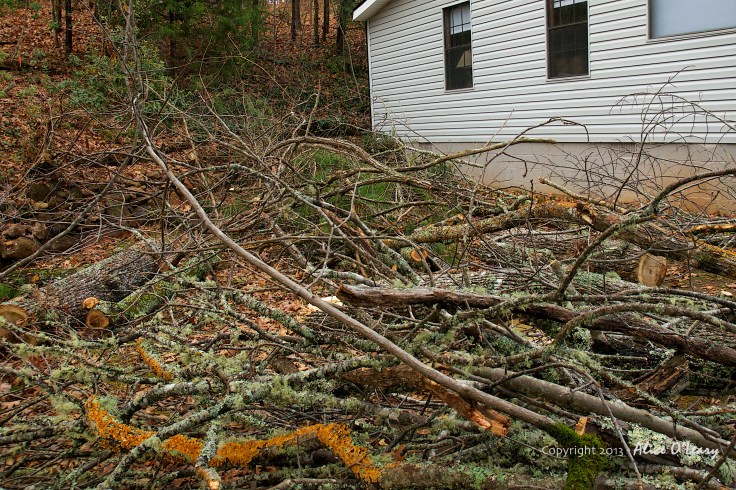
Saturday dawned mild and sunny. When I looked at the pile of tree debris in my backyard I thought of one thing–opportunity!  It’s not often that the opportunity to study macro-environments at 80 feet up falls into your lap. Normally you need to strap on a lot of climbing equipment and be strong enough to claw your way up a tree with your heels.  I have neither the equipment, strength or, for that matter, the interest to even try.  Another opportunity to accomplish this goal is to visit a few places, like Myakka River State Park, where there is a tree canopy walk and you can leisurely study the flora aloft.   In my case, on Saturday, I simply needed to walk out my front door.

I spent some time studying the downed pieces. There were many things of interest. Lots of lichen…or moss…not sure which. But the limbs from the Black Oak gave me something I could identify, another addition to the growing list of mushrooms I have become acquainted with here in North Carolina. In this case it is the Crowded Parchment (Stereum complicatum).  They are the orange fungi you see on the branches at the bottom of this first picture.

But here is a much better and closer picture.

Image #152 (2)

I had studied the dead limbs of the Black Oak with some interest before the arborists arrived but I can’t recall seeing the fungi. No doubt it was on the sunny side of the branch which was some 60 or more feet in the air.  Having photographed and identified it I then learned, via the Audubon Society Field Guide to North American Mushrooms, that the habitat for this fungi is  “On dead deciduous twigs and stumps, especially oak.”   Seems the arborist made a good cut.  ❧

Image #144 – Changes

Image #144

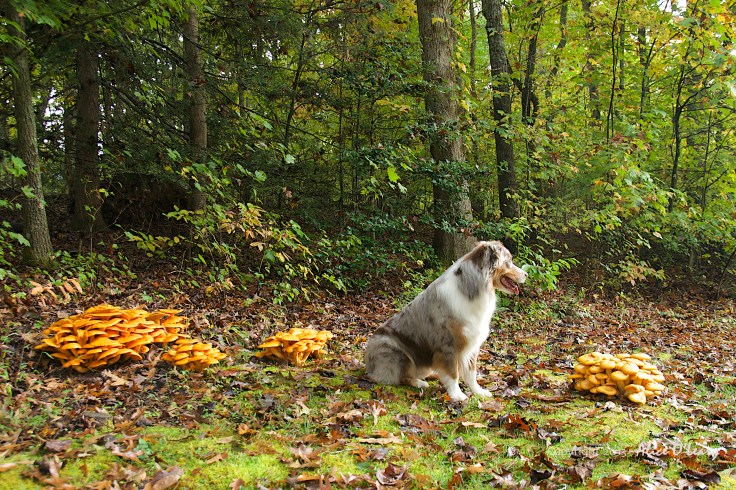
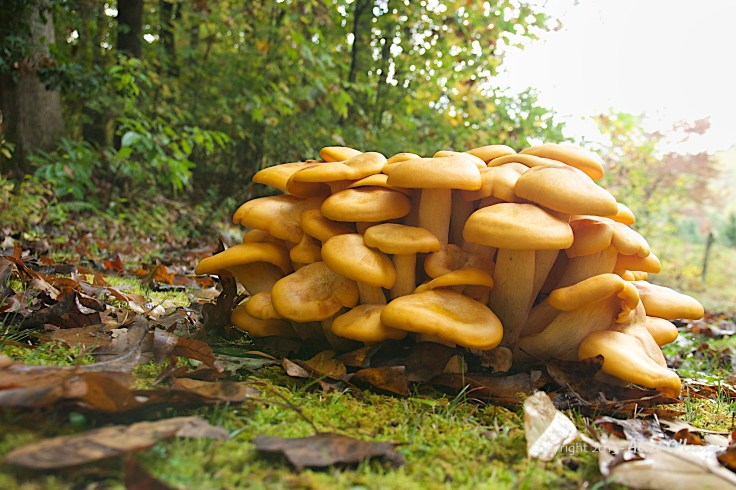
Frequent followers will have figured out by now that this summer, for me, has been a photographic love affair with mushrooms.  That’s my buddy, Tango, sitting between two spectacular blooms of mushrooms in the patch of land that Boni & Gail call “the meadow,” at the top of Fawn Hill.  This picture was just three weeks ago.   On the right is an, as yet, unidentified stand. They may be Velvet Foot but I’m not sure.  On the left is our spectacular friend, Jack O’Lantern.  Tango’s presence gives a good sense of scale. These are not small ‘shrooms.

Here they are, a bit closer up.

Unidentified mushrooms, possibly Velvet Foot.
Image #144(B)
Jack O’Lantern mushrooms

Three weeks may not seem like much time but, believe me, it is a long time ago. There have been many changes. The most dramatic and heart-wrenching were detailed in my previous post, Image #143.   My friend Gail is slipping, bit-by-bit, into that abyss from which there is no return…at least none that we can know. She has talked of the bright light at the foot of her bed. A Reiki master, who came and gave Gail great comfort on Sunday, spoke of the “bright blue light” that is next to Gail.  Change is coming…

On a larger scale, the air is cooler now, frosts are frequent and the leaves have fallen with a thud that announces “CHANGE!”  Sigh …. it is inescapable. Throughout the summer months we trick ourselves somehow, we believe the days, long and lingering, will go on forever. But change is here and in these northern climes it is ever so much more present. Perhaps that is why the elderly love Florida so much. Change is harder to see and there is a sense that change is being held at bay.  As humans we generally hate change and yet, ironically, it is the only thing of which we can be absolutely sure.

And speaking of change, frequent followers will note some changes on this website. I have finally figured out how to create galleries for my pictures. You can find them in the right-hand column. So far I have posted two — one with birds and the other with, what else, mushrooms.  I hope you enjoy this chance to view just the pictures but, of course, I also hope you will stop to read the words. After all, words matter. ❧

Image #139 – Carnival Candy Slime

Image #139

Like Halloween caviar, the Carnival Candy Slime fungi brightens the base of a rotting tree in Joyce Kilmer Memorial Forest. Carnival Candy Slime!!!  Where do these mushroom specialists come up with these names??  Its Latin name is Arcyria denudata.  I may not have it correctly identified and encourage any slime lovers out there to set me straight if I have the name wrong.  A truly spectacular growth, whatever its name might be. ☙

Image #137 – Stalked Hairy Fairy Cup fungus

Image #137

According to the National Audubon Society Field Guide to North American Mushrooms,  “The Stalked Hairy Fairy Cup is one of a number of very small, beautiful cup fungi that are covered with hairs.”  Enough said?  This dainty life form lives on a tree at Wayah Bald, NC — 5,000 feet up, very exposed to extremes and very beautiful. ☙

Image #127 – Violet Toothed Polypore

Image #127

About three inches in height, these Violet Toothed Polypores are very similar to Turkey Tails but their color, to my eye, is far more appealing.  There was about a 2-3 foot stand of them on a fallen log in Joyce Kilmer Memorial Forest.  ☙

Image #124 – From Little Helmets to Shaggy Manes

Image #124

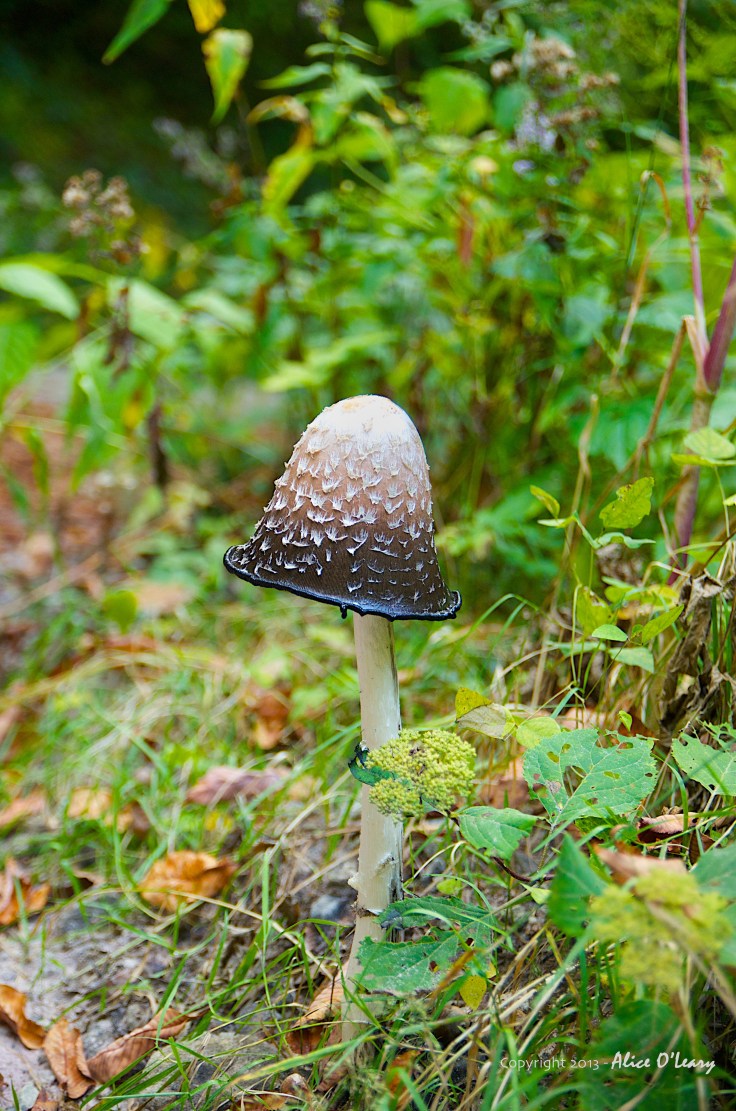
Reportedly it has been a bumper-crop-year for mushrooms in western North Carolina.  Lucky me!  A few days ago I posted Little Helmets, lovely white fungi that are about 2cm in height (about 3/4″). Today I present a 20+cm beauty, a Shaggy Mane (Coprinus comatus) discovered along the road to Wayah Bald.  Remarkably these two mushrooms are in the same family (Inky Cap or Coprinus)!  But they certainly present differently. The Little Helmets were all clustered together near a woodpile. The Shaggy Mane stood in solitary splendor at a hairpin curve on Wyaha Bald Road. ☙Image #124(a)

Blog at WordPress.com.

Up ↑