Image #173 – Grieving Geese

Toulouse goose (gosling)
Toulouse goose (gosling) – June 2010

My friend Mary is mourning the loss of her male Toulouse Goose. His name was Doodle and he was twelve.  Three and a half years ago he fathered several goslings and I was fortunate enough to get their pictures.  Doodle is survived by a mate and two daughters who are greatly grieving his loss.  Mary wrote on Facebook,

After 12 good years of life he has passed over the Rainbow Bridge. If dogs and cats can go over, why not a much loved goose. His much younger mate and their two daughters are very lonely without him. If anyone has or knows of anyone within 100 miles of Sarasota, Fl who has geese please put me in contact with them. Many thanks.

The new male has big wings to fill. Doodle was an excellent protector and, of course, had been with his ladies for many years. Change is hard for all of us mammals.  I certainly wish the survivors well.  ❧

Image #172 — Seasonal Bounty

White-breasted Nuthatch (Sitta carolinensis)

Frequent followers will recall the recent post of a Tufted Titmouse with a mouthful of seed.  Here is a White-breasted Nuthatch with a similar bounty.  The nuthatch and titmouse are often in the company of one another and have similar feeding habits. Our friends at the Cornell Lab of Ornithology enlighten us more on this pleasant bird.

White-breasted Nuthatches are active, agile little birds with an appetite for insects and large, meaty seeds. They get their common name from their habit of jamming large nuts and acorns into tree bark, then whacking them with their sharp bill to “hatch” out the seed from the inside. White-breasted Nuthatches may be small but their voices are loud, and often their insistent nasal yammering will lead you right to them.

Image #171 – Downy Woodpecker (Picoides pubescents)

Downy Woodpecker  (Picoides pubescents)
Downy Woodpecker (Picoides pubescents)

The Downy Woodpecker  (Picoides pubescents) always seems so studious to me.  It will invariably go straight to the suet as opposed to the Red-bellied Woodpecker (Melanerpes carolinus) who will often swing awkwardly from one of the feeders, flinging out seeds until it finds just what it wants. The Downy knows exactly what it wants.

The Downy and the Hairy Woodpeckers are very similar in appearance with the Hairy Woodpecker the larger of the two. So far I am fairly certain I have only seen the Downy here on Fawn Hill. I have seen the Hairy Woodpecker in the past and it is significantly larger.  None of the black and white woodpeckers that I have seen this summer have been that large.

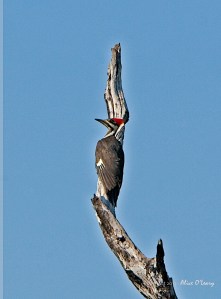
Pileated Woodpecker (Dryocopis pilestus). Taken in Florida in 2006.

Of course there is the largest of the black and white WPs, the Pileated Woodpeckers and I have to admit I was surprised to see them here in North Carolina. I have often seen the Pileated in Florida and in my head I thought of the Pileated WP as exclusively Floridian.  Silly, I know. I think it has to do with their pre-historic look.  They seem perfectly at home in the scrub and swamps of Florida. Catching sight of them in the woods around my home here on Fawn Hill was a pleasant surprise. ❧

Image #170 – Um, You May Want to Rethink that Bite

Tufted Titmouse (Parus bicolor)

It seems this Tufted titmouse (Parus bicolor) may have over-judged his ability to swallow but with a prize that large you can understand his inclination.  The Cornell Lab of Ornithology offers this helpful insight:

  • Tufted Titmice hoard food in fall and winter, a behavior they share with many of their relatives, including the chickadees and tits. Titmice take advantage of a bird feeder’s bounty by storing many of the seeds they get. Usually, the storage sites are within 130 feet of the feeder. The birds take only one seed per trip and usually shell the seeds before hiding them.

After reading this helpful tip I watched the birds more closely and, sure enough, they grab a seed (or a nut) and fly quickly away to store the prize and they are back. One enterprising titmouse has begun to stash the bounty in the nooks and crevices of the deck thereby saving time and energy.  I have a Turkey Oak nearby that is, no doubt, one of the primary storage spots for the birds. The gnarly bark offers perfect hiding spots although I suspect the squirrels may be finding many of the stash sites.  ❧

Image #169 – Mourning Dove (Zenaida macroura)

Mourning Dove (Zenaida macroura)

This pretty little dove makes me think of a ballerina–it’s the lovely arch in the neck.  Mourning doves are present throughout the United States and in summer months they even migrate into Canada.  It’s a wonder they survive at all. They build nests that are impossibly flimsy and often in very public places. I recall a retirement home in Florida where a dove had built her nest directly above the door leading to the patio area. She would sit there all day, not moving a muscle as people by the dozens came and went.   The residents of the home were delighted to have the nest so visible and I have no doubt their collective karma guaranteed the successful fledge. ❧

Image #168 – Female Cardinal (Cardinalis cardinalis)

Female Northern Cardinal (Cardinalis cardinals)
Female Northern Cardinal (Cardinalis cardinalis)

The flock of Northern Cardinals continues to populate my feeders and they are a joy to see.  I am accustomed to seeing Cardinals as couples and I was surprised to learn that flocks are common in the winter months.  With four males and three (maybe four) females they certainly bring some lovely color to an increasingly bleak landscape.  

This female has beautiful color in her wings. At first I wasn’t sure if she was a juvenile or an adult. Image #168(a)It is the crest that tells the difference and she obligingly shook her head revealing a crest of a delightfully punkish orange.  On a juvenile there would be no color and a brownish crown as opposed to a crest.  So, I would say she is a young adult. ❧

Image #167 – The Squirrel Cafe is Open

Image #167

A few posts back I wrote about squirrels being a pain when it comes to keeping bird feeders full and the truly effective way that some North Carolinians take care of such a problem — they shoot them. My friend Mary took exception with such extreme measures and described how she feeds the squirrels around her house.  Her comments resonated with me, especially when I considered that my sister and brother-in-law are currently fostering two orphaned flying squirrels.  There is, after all, a yin and a yang in life. We must honor that.  So I set up a small squirrel feeding area on my deck using pieces of lumber from our recent tree removal.

As the picture demonstrates, the squirrels have found this solution very much to their liking.  They have, for the most part, stopped raiding my feeders.  I seem to have 3 squirrels that regularly visit my deck. If they get too obnoxious I set Tango loose on them and they scatter in every direction.  He enjoys the romp and its best to keep the squirrels on their toes. My neighbor had some horror stories about squirrels chewing their way through screening to get food from inside the house.  I sure don’t want that. ❧

Image #166 – Gaping Gator

Alligator at Myakka River State Park

I’ll be heading down to Florida soon where I plan to spend a few weeks. Looking forward to getting back out to Myakka River State Park and taking more gator pictures, like this one.  Unless there is a severe drought the odds are very good that you will see a gator at Myakka.  They are all over the place out there.  Best of all they love to congregate by the Park Drive bridge which makes getting photos like this one quite easy and safe. ❧

Image #165 – Nine Turkeys Trotting

Image #165

This picture of wild turkeys was taken last year at Myakka River State Park. There was a time at Myakka when wild turkeys were nearly extinct.  They were aggressively hunted in Myakka Park and  a part of me can understand why. The meat of these turkeys would not be anything like the Butterball that some of you cooked last week for Thanksgiving. But I feel certain it was satisfying never the less.  And wild turkeys have beautiful feathers that no doubt pulled down a nice chunk of change in the early decades of the 20th century when women’s hats were elaborately adorned with feathers.  Living here in North Carolina, where poverty is a very real thing, I find myself thinking about all of this in a different way. It takes me back to my very early days in New England when I recall many classmates who were malnourished and poorly clothed, but once we moved to the gleaming Gulf coast of Florida it seemed poverty went into my rearview mirror. I suppose that was the goal. Still, these “pockets” of poverty are with us and extend to our urban areas as well. Any one who has watched the news in recent days has probably heard about the battle for a higher minimum wage. The current requirement of $7.25 an hour is a pittance and can barely sustain a single individual much less a family. If you want a concise essay on that battle I suggest the article by Richard Trumka and Christine Owens on CNN.

We’ve managed to protect the turkeys in Myakka and they are flourishing. Can we find a way to help our fellow human beings? ❧

Image #163 – Angry Birds anyone?

Image #163 (1)
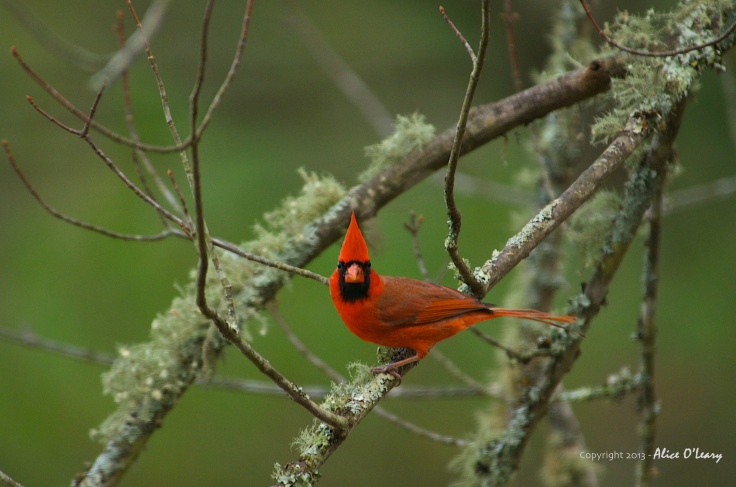
Northern Cardinal  (Cardinalis cardinalis)

Anyone who has ever played “Angry Birds” knows that look!  Northern Cardinals are endlessly enchanting. I seem to be over-run with them these days. I counted seven at the feeder today– 3 males and 4 females. So stay tuned for more Cardinal pictures. ❧

Blog at WordPress.com.

Up ↑