Image #154 – Stalked Hairy Fairy Cup

The Stalked Hairy Fairy Cup, according to Audubon’s Field Guide to North American Mushrooms, is “Often in large groups, on dead twigs, stems, beech burs, and birch catkins.” That explains the large number of these specimens that were populating the various pieces from our recent tree removal on Fawn Hill.  There were plenty of dead or dying stems and twigs for this fungus to enjoy.Image #154(1) At approximately 1/8 of an inch (3mm) in length is is very easy to overlook this unique mushroom.  The actual cup is only 1/32 of an inch (1mm) wide.  When you get down close to it you see that is is covered with long, white hairs. Just another wonder from the mushroom world. ❧

Image #154

Image #153 – Between a rock and a hard place

Image #153With the temperature falling into the teens  last week, critters all over these Carolina Hills are re-doubling their efforts to prepare for winter.  Staying warm is a definite priority for mammals so you can’t blame a little field mouse for squeezing himself into the warmth of an aging double-wide with lots of little gaps and holes.

I first noticed mouse droppings about three weeks ago. They seemed confined to the kitchen sink area so, taking advice from my neighbor, I plugged all the holes I could find with steel wool. The problem is that field mice are tiny and can squeeze through openings that are unbelievably small, so small that humans do not even see them sometimes.  Ridding my home of mice could be a challenge and a trauma. The mechanical and chemical means of eliminating such creatures are not for the faint of heart. Remember, dear readers, this is a woman who has owned and loved gerbils.

Two nights ago I heard rustling in the cabinet where I store things like crackers and egg noodles. Tango Dog and Rainbow Cat, sat transfixed in front of the cabinet, looking up as if watching a big screen TV on the wall. I opened the door and there he was, nestled happily in the new, and previously unopened, bag of egg noddles. The clear plastic packaging made for perfect viewing. We made eye contact and then he was off like a shot.

I reapplied steel wool, moved the dry goods to plastic tubs, cleaned up and hoped for the best.

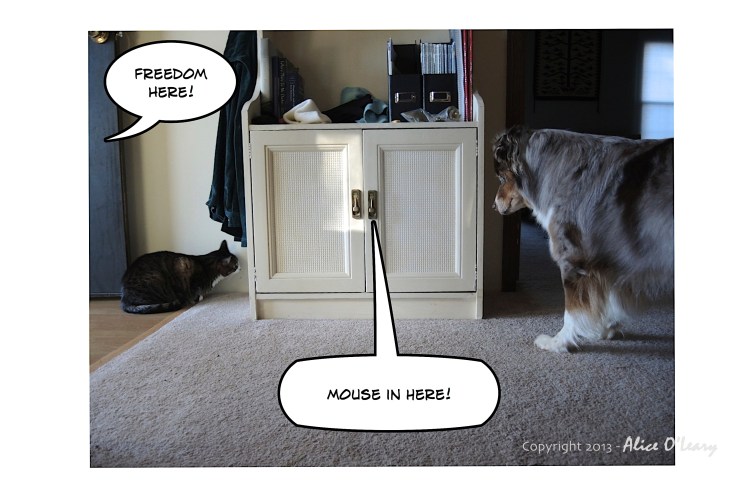
The next night, at about 3 a.m., I awoke to a ruckus in the living room. It was the cat and I knew immediately what was going on. Switching on the light I found the cat by the hall cupboard, peering intently behind it. The mouse was cornered. Tango quickly joined in the fun. Realizing there was nothing I could do, I wished the mouse well and went back to bed.  I suspect Rainbow was there most of the night, waiting for the rodent to make a misstep. Tango, being no fool, came back to bed with me.

Image #153(1)This morning the mouse was still cornered. As I came out of the bedroom I looked behind the cupboard and there he was. His little head emerged from an opening in the back of the cupboard. It quickly pulled back when he saw me. Tango saw all this too and he was back in the hunt.

Thankfully it was a wonderfully mild and sunny morning. I propped open the front door and hoped the mouse was smart enough to make a dash for freedom. It took a while for  the coast to clear. The cat lost interest and went for her pre-nap nap.  Tango stayed on the case but eventually his interest flagged as well.  The mouse, I think, made his escape. There was a brief skirmish by the door and Tango went running to the deck and down into the hedge.  I’ve seen no further signs of the mouse today.  Guess we’ll learn more tonight.  Of course there is never just one mouse …  ❧

Image #152 – Opportunity!

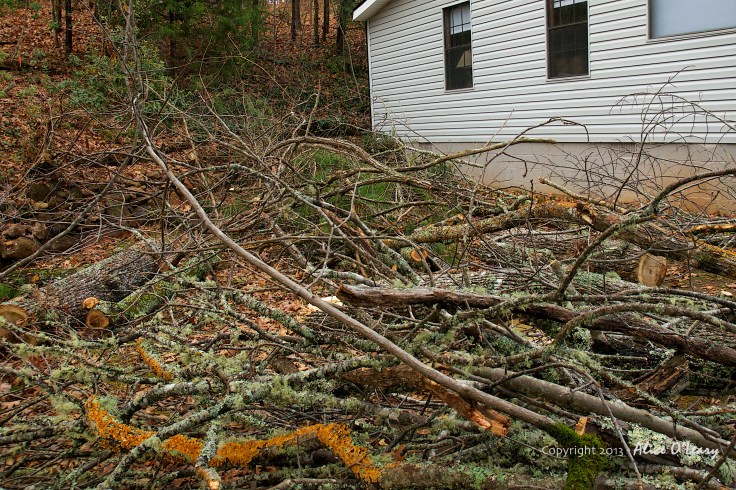
On Friday we had some tree removal work done at Fawn Hill. There were two really bad problems–an 80 foot Poplar that was rotted at the base and hollow for about six feet up, and some limbs on a Black Oak that had died and were hanging precipitously over the house.  One piece of the Oak had already broken lose and, like a spear, pierced the roof.

The crew was here early and it was a good thing because by midday the rains had come in and the crew headed out, leaving massive quantities of lumber staged in my backyard and driveway, Image 152(1)awaiting the chipper that may arrive on Monday, weather permitting.

Saturday dawned mild and sunny. When I looked at the pile of tree debris in my backyard I thought of one thing–opportunity!  It’s not often that the opportunity to study macro-environments at 80 feet up falls into your lap. Normally you need to strap on a lot of climbing equipment and be strong enough to claw your way up a tree with your heels.  I have neither the equipment, strength or, for that matter, the interest to even try.  Another opportunity to accomplish this goal is to visit a few places, like Myakka River State Park, where there is a tree canopy walk and you can leisurely study the flora aloft.   In my case, on Saturday, I simply needed to walk out my front door.

I spent some time studying the downed pieces. There were many things of interest. Lots of lichen…or moss…not sure which. But the limbs from the Black Oak gave me something I could identify, another addition to the growing list of mushrooms I have become acquainted with here in North Carolina. In this case it is the Crowded Parchment (Stereum complicatum).  They are the orange fungi you see on the branches at the bottom of this first picture.

But here is a much better and closer picture.

Image #152 (2)

I had studied the dead limbs of the Black Oak with some interest before the arborists arrived but I can’t recall seeing the fungi. No doubt it was on the sunny side of the branch which was some 60 or more feet in the air.  Having photographed and identified it I then learned, via the Audubon Society Field Guide to North American Mushrooms, that the habitat for this fungi is  “On dead deciduous twigs and stumps, especially oak.”   Seems the arborist made a good cut.  ❧

Image #151 – Red-headed birds

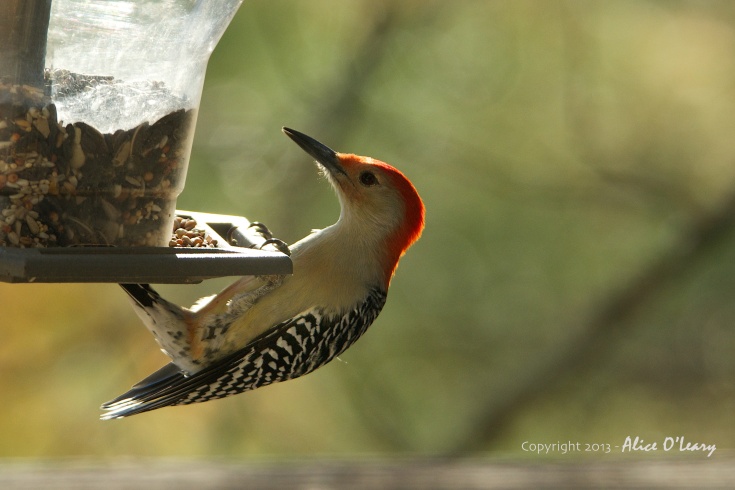
Image #152

If you think this is a Red-headed Woodpecker you are wrong…but you are not alone.  Thinking this is a Red-headed Woodpecker is one of the most common birding ID mistakes.  While I couldn’t find an absolute statistic my bet would be that 90% of the people who see this bird think “Red-headed Woodpecker.”   Actually he is a Red-bellied Woodpecker although none of my field guides indicate an actual red-belly.  Such are the problems of birding ID’s.

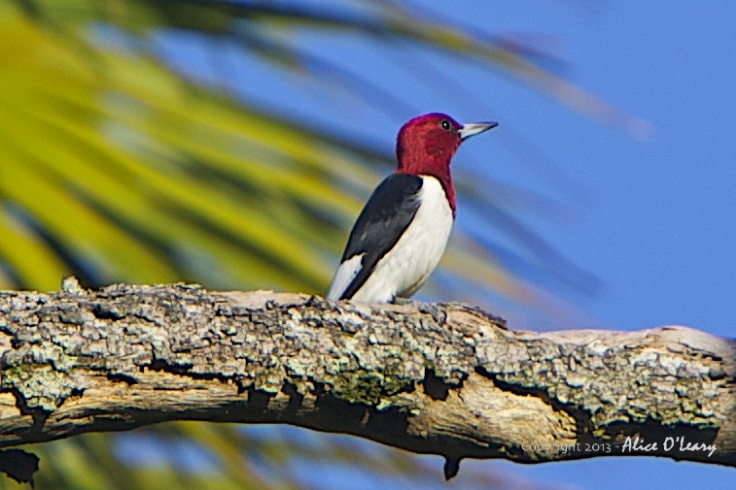
This is an actual Red-headed Woodpecker and they are not nearly as common as their colorful cousins.   Image #151 (1)This particular Red-head was a resident at the Carlton Preserve in Venice, Florida and for several years you could count on seeing him at the entrance to the preserve in a grove of decaying trees. I told an honest-to-God ornithologist (bird expert) about the Red-headed Woodpecker at Carlton Preserve and he poo-pooed the possibility, insisting I was actually seeing a Red-bellied Woodpecker.  So I suggested we go to Carlton Preserve together and he agreed.  We had walked just a few feet into the entrance when this handsome Red-headed Woodpecker flew to the same tree in this photo.  My ornithologist friend was so surprised that he dropped his camera. He spent the rest of the day expressing awe that it really was a Red-headed Woodpecker and that I was right!   I can’t recall if I ever saw the ornithologist again but the Red-headed Woodpecker was great entertainment for several more years. They are still at Carlton Preserve but the ones that foraged near the entrance seem to have moved on.  My guess is they grew weary of too many ornithologists making fools of themselves. ❧

Image #150 – The Pool Has Closed for the Season

Image #150 (1)

That’s my backyard bird bath this morning.  It was chilly here, actually downright cold. When I awoke it was 15º F.   The birds are flocking to my feeders in great numbers and who can blame them? I can barely comprehend how they manage to survive in such weather but clearly good nutrition is a part of it.  Just yesterday I was talking with my neighbor about bird bath heaters.  She was talking about the need to get her’s in place and I was marveling that such an item existed. It never occurred to this Florida girl but I’ve already been to Amazon.com to check it out and this morning certainly confirms the need for such a device.  There are some technical issues to resolve, however. So, for the next few days at least, my feathered-friends will have to try skating.  Thankfully the weather is forecast to moderate and by the weekend we will be back in the 60s. ❧

Image #149 -Little Tennessee River Greenway

Image #149

Running through Franklin’s rather erratic downtown area is a lovely stretch of land known as the Greenway which is maintained by the delightfully acronymed group – FROGS.  Friends of the Greenway (FROGS) maintain the paths, weeding out invasive plants along the five mile stretch while also providing a comfy headquarters with coffee shop and books. The park meanders along several miles of the Little Tennessee River. During a walk last week I snapped this photograph.  As the trees continue losing their leaves there are new designs emerging from the dense growth. The trees become dancers against the wintering sky. Soon all the leaves will be gone and these trees will stand naked and exposed. Yet, remarkably, they are safer that way. Leaves are heavy, so is snow and ice.  Exposed limbs have a better chance of surviving the onslaught of winter. Nature is remarkable. ❧

Image #148 – Putting on a new coat — seasonal changes in the bird world

Image #148

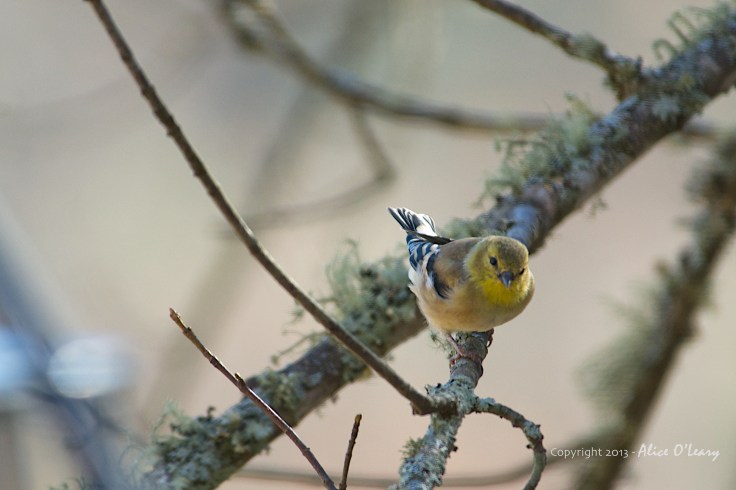
Previous posts have included pictures of the American Goldfinches who have graced my feeder throughout the summer (Image #141).  Now it is mid-fall and  mating colors are gone . I learned today that the American Goldfinch is the only finch to undergo a complete moulting process.   So the bird in this picture could be the same as the bird in Image #141.  But American Goldfinches are also migratory so this may be an entirely different bird.  This bird, according to The Sibley Guide to Birds, is a an adult, non-breeding.   While not as dramatic as the male American Goldfinch in his mating finery he is still a very handsome bird. ❧

Death of a Friend

IMG_0403

My friend, Gail Walton, died today, She was 69 years-old.  That’s her in the picture, on the left in the blue shirt. She is with her life-partner of more than twenty-five years, my college friend Bonnie Powell.  The picture was taken in 2000, not long after they got McDuff, the Jack Russell Terrier in the middle.

Gail was a wonderful woman with a big heart. She loved dogs and rescued her fair share of abandoned or abused critters.She ran a pet supply business for a while. She was also a respiratory therapist, a gourmet cook, an M.P. when she was in the Army, and a whole assortment of other occupations or pre-occupations. She was witty and beautiful.

Fawn Hill feels a little lonely tonight. A year ago I never imagined I would be living here, neither did Gail and Bonnie.  After I moved here in June we talked about how incredible it was that we had become neighbors. Gail said, “Alice, I believe some energy has brought you here.” Just a few weeks later she was diagnosed with an advanced case of recurring lung cancer. Eight years ago she had a lung removed and the doctors felt they had gotten all of it. But they didn’t. By the time Gail was diagnosed, just over four weeks ago, the cancer was everywhere. There was nothing that could be done. Hospice was brought in.

Hospice was my occupation for the last six years of my working career. The irony that I would arrive here just before Gail’s awful diagnosis was not lost on any of us. I did the best I could in advising and helping. I have to say, however, that administering hospice care to a friend is so much harder than administering such care to others. When I was working for hospice people would often ask me, “How can you do that kind of work?”  I would explain that there was a certain level of detachment, which is not to say disinterest or aloofness,  but rather an acceptance that death is inevitable and that dying patients deserve compassion and competent care.

When the patient is your friend or a family member (and I have had experience in both instances) it seems that all you have learned in ministering to the dying patient just goes away and you feel helpless. You lose the objectivity that is normally present. Your thought process seems fuzzy and muddled. Actions and reactions that once seemed so sure and competent become tentative. The shroud of grief becomes becomes a straight-jacket that seems to paralyze you.

We did the best we could in caring for Gail. She was surrounded by loving friends and, for the most part,  we were able to control the pain. Still, it has been a difficult time that has once again brought home the fundamental truth: Life is short. Carpe diem! ❧

Image #146 – White-breasted Nuthatch

Image #146

The variety of birds at my feeder has narrowed to about 6-10 varieties. The White-breasted Nuthatch is one of them and he is a surprisingly cooperative subject. The Titmouse and Chickadee are frenetic and move too quickly to grab the right focus. But this little fellow looked right at the camera and smiled.  Don’t you agree? ❧

Blog at WordPress.com.

Up ↑