Did you know there are between 200-400 billion birds in the world at any given moment? Even at the low side (200 billion) that’s a lot of birds. Yet we know so little about them. I recall a comic once who built a routine around the fact that you never see baby pigeons. He had a point. You also rarely see dead birds. There are the road kill bodies, usually sea gulls who were too greedy and too stupid to get out of the way. But with all the birds around it seems as if you would, on a fairly regular basis, see dead birds in your yard, in parks, at the seashore … you know, places where birds hang out. But you don’t.
So, it was with complete and utter amazement that I found a dead hummingbird in my front yard. I caught a glimpse of his tail feathers and dismissed it as a mushroom but something made me turn back.
There he was, nestled down into the tall grass. Had he fallen from the tree? Did a gust of wind catch him the wrong way and drive him into the Augustine grass? Upon picking him up I dismissed the idea of a predator. He was fully in tact, no sign of blood or trauma. And so light … featherweight indeed. There’s the obvious joke about birds finding the hospice nurse home and kicking the bucket. But we’ll probably never know why this little guy was dead on my front lawn. It was a wonderful opportunity to hold a hummingbird and experience the lightness of a remarkable being. Naturally I snapped some pictures to preserve the memory. I doubt this will come my way again.
I dropped by my WordPress dashboard tonight to see what the stats might be for my latest post, a bit of fluff about my cat. I realized I had several posts in the draft file and the following is one of them. It is eighteen months old and I no longer work as a grief counselor but it is a fairly good piece of writing and captures some of the angst that a counselor can go through when trying to help the griever. I’m not sure why I didn’t publish it back in 2011. Better late than never I suppose.
❖ ❖ ❖ ❖ ❖ ❖ ❖ ❖ ❖ ❖
As a grief counselor I see people in a number of different ways; one-on-one, educational presentations, and group support are the main three. I prefer one-on-one because, okay I’ll say it, I like the sense of control. In a one-on-one you can lead a client and you can also challenge a client. If you hear the client going off-track, for example, you can attempt to steer the person back to the matter at hand…their grief. You can gently remind them that all those other problems were there before the death of a loved one, they were not caused by the death. If they will not be guided gently you can, eventually, draw the line in the sand and challenge their actions. More often than not it is a very effective therapy.
Groups are far more…shall we say liquid? The groups at my hospice are not the highly structured, 6 to 8 week course in grief with homework and journals. Our philosophy is that grief requires support and companioning. Generally we prefer grief-specific groups. For example, spousal loss, traumatic death, sibling loss, etc. But we also have the General Grief Group and that, my friends, is always an adventure.
I like to use my general groups as a means to discover which specific group the individual should move on to. For that reason I rarely have the same people at my general groups more than 2 or 3 times. Sometimes people are there once and I’ll not hear from them again even though I make follow-up attempts. I like to think they have gotten what they needed and moved on. For 85% of the bereaved counseling is unnecessary. They have the support of family and friends. They seek “counseling” to hear that they aren’t crazy, that it’s okay to “talk” to the deceased; it’s alright to keep Joe’s sweater so you can “hug” him; dreaming of your departed wife of 63 years does not make you nuts, it makes you normal.
But the thing about general grief groups is that they can make me a little crazy. Every session is a smorgsboard of grief. You never know what the mix of the group will provide but it is always interesting. It’s a bit like Russian roulette with grief.
One of my first group sessions is a perfect example. I had already been on the job for a couple of months, doing many one-on-ones. I’d been working with one woman whose mother had died and she was being subjected to some borderline abusive behavior by her father. She had legitimate grief issues but it was difficult to convince her of that. Her father kept telling her she should “be over it” and when he started dating just a few months after the mother’s death it was very hard on the daughter. We reached a point where the one-on-ones were not getting us anywhere and I suggested she try a group. Since my newly formed general grief support group was meeting in a few days it was natural to suggest that group.
Big mistake.
About nine people showed up. I knew only one, the woman whose mother had died. She looked nervous so I decided not to start the “introductions” with her. I chose the lady immediately to my client’s right. “Well,” says I, “What has brought you to our meeting today?”
“My two-year old grandchild died in an accidental drowning.”
Have you ever been in a room when all of the oxygen was sucked out of it? That was the net effect of this woman’s statement. Everyone in the room, including me, had to pick their jaw up off the table. A declaration of this magnitude renders the grief of everyone else as “minor.” It’s not true, of course, but there is a part of us that immediately capitulates to grief of this magnitude. We know at our very core that this kind of grief demands more attention.
And attention was paid. All of us bore witness to this woman’s story of unfathomable grief. And when she had finished it was time to move on to the next…my poor little woman who had lost her mother. We don’t like to compare one type of grief to another but I could tell my client was deflated. The work of six weeks flew out the window. Her father, I suspect with many years of practice, had already driven this woman into a sense of worthlessness. He had badgered her about how well her mother had cared for him and why couldn’t his children do the same? And now, unwittingly, I had plopped her into a scenario that only re-enforced her sense that she was exagerrating the grief of losing of her mother.
My most recent general grief support group was equally diverse. There were four participants: a mother and and her teenage daughter, a late 50s woman, and an 85 year old man. The man, either by generation or gender, assumed the stage and pronounced his grief. It was profound. He had lost his wife of 63 years (in the interest of full disclosure I feel it is important to tell the readers that I am 63 years old). One day she was complaining of backache, within a week she was dead of some cancer. He was, to put it simply, lost.
The mother with her daughter had lost her husband to a massive heart attack three years ago. She and her children have been in a trauma induced fog but life is beating at the door. The bank wants to repossess the house, the wife has only recently acquired a job. The daughter is a junior in high school.
The fourth participant is dealing with anticipatory grief. Her husband is terminally ill but not yet gone. She is there, she says, because she has some problems with denial.
The pain in this room is huge and diverse. A smorgsborg. The widower rather quickly sees that his case, while sad, is not grim. He wishes he had met the woman and her daughter before he gave away all of his wife’s “expensive clothes.” I look at the mother and daughter, trying to imagine them in the clothing of a deceased woman who married her World War II hero and spent the next six decades dancing at the Elk’s Club every Saturday night. My mind is racing, trying to focus, trying to figure out how I will meld this group so that everyone gets something.
It’s not always this pretty.
And soon I realize, as I always do, that it really isn’t up to me. It is the participants who must find their way and they are doing so. There is, in every group, a magic moment when, for a brief moment, every soul in the room melds with the others. And it comes from the most unexpected person.
On this night it was the woman whose husband still lived. She was quiet throughout the night and the man noted that and asked about the sorrow she was bearing and how she was coping. He was clearly stunned at the burdens of the mother and daughter. I think he feared that this quiet woman to his right may have deeper, even darker tragedies. I have met with this woman, one-on-one, numerous times, and have a fairly good idea just how deep her sorrow is. I waited for her reponse. She took her time and, in a measured tone said, “Well, I keep thinking that maybe I should just go out and have a beer.”
There were laughs all around. The man offered to take her for a beer. The mother said she would join them. And the teenager? She had that sly grin of a girl, hangin’ with the adults and transitioning to a woman.
I can’t say that any of them had that beer. They all seemed to go their separate ways at the door. But in that last 30-40 minutes, after the beer remark, they were a group, they were friends, and each asked about the next meeting. Will they be there? Your guess is as good as mine.❧
The death of News of the World, the last flight of the space shuttle, and the debt crisis: these items dominated the Sunday morning talk shows today. In recent weeks I have found myself returning to these “weekly roundups.” I can barely tolerate the 24/7 coverage of CNN or MSNBC and will not even consider Fox News, although I have tried. But the “roundup” shows seem to capture the important points and this week’s topics, while seemingly disparate, do seem to have a similar thread to me: they have all been hoisted on their own petard.
The petard doesn’t figure in with too much of our history these days but at one time it was as vital to soldiers as the tank or the canon is today. The petard was a small bomb that was used to blast open doors or make holes in castle walls. From what can probably be assumed as a humble beginning, the petard evolved to a major weapon of war, used to blast an army’s way into castles and other fortifications. According to Wikipedia, “a common tactic was to dig a shallow trench close to the enemy gate, and then erect a small hoisting engine that would lift the lit petard out of the trench, swing it up, out, and over to the gate, where it would detonate and hopefully breach the gate. This procedure might go awry; the engineer lighting the bomb could be snagged in the ropes, lifted out with the petard, and consequently blown up.” Hence he was hoisted on his own petard.
The phrase became well known complements of William Shakespeare’s tragic hero, Hamlet, who hoisted his schoolmates Rosencrantz and Guildenstern on the petard of Hamlet’s wicked uncle, King Claudius. The plot was to have R&G assist with the destruction of Hamlet but the clever Dane turned the table and it was R&G who died.
Without question the News of the World wins the Hoist award for the week. The British scandal sheet has printed its last edition and, seemingly, hacked its last phone. The British public seemed quite content when the only phones hacked were those of the Monarchy — British or Hollywood style. But when the “reporters” turned their hacking on a missing 13-year old girl who was eventually found murdered the public turned on a dime. Worse yet, it was revealed in this same week that the eavesdropping and email snooping extended to the fallen heros of Afghanistan and Iraq, perhaps as many as 4,000 families of soldiers. The British, quite rightly, do not take to the ghoulish invasion of privacy that this story suggests. After all, what was the point? To listen to heartsick family members mourn the loss of their brave soldiers? To perhaps hear anger at British policy that has supported a decade-long war? It is incomprehensible and no amount of recompense can resolve this gross violation of privacy but attempts will be made. As early as April the paper’s parent company, Rupert Murdock’s tainted News International, established a ₤15 million compensation fund for hacking victims. The writing was on the wall even then. Today the estimate is closer to ₤120 million and the damage has only begun to surface.
Mr. Murdoch, being no fool, has tucked his tail and turned the other way. While the “reporters” and hackers at NoW have already been hoisted it remains to be seen if the General will get his comeuppance. One can only hope.
Meanwhile, the space shuttle Atlantis is orbiting around the world for the last time and upon its (hopefully) safe return the shuttle program is no more. As one who has thrilled to the accomplishments of the space program from its very beginning I cannot help but feel we are loosing far more than a “space truck”. I can remember Alan Shepherd’s 15 minute blast into space. My high school day stopped dead and, what few TVs we had, were tuned to the grainy, black-and-white event. Students crowded cheek-to-jowl to see the blastoff and anxiously await the recovery. In December 1968, while in college, I witnessed the blast-off of Apollo 8 on a cold beach in Florida. I felt the thunder of the Saturn 5 rocket shake the very core of my being and watched the ascent of three brave men who were going to the moon, albeit just to circle that orb a few times and then head home. But wonderfully those orbits came on Christmas Eve and the words of Genesis read by Frank Borman were universal enough to appeal to people of all faiths, to all the people of this world. It was an earth uniting moment that gives me chills even today as I write. It was a colossal moment of hope.
Space shuttle arrived with perhaps less sex appeal. No moon trips for this baby. But it would do great things. We were sure of that. And it has. The international space station is no small feat and repair of the Hubble satellite alone was worth the investment. Those of us who grew up in the glamor days of space travel knew that nuts and bolts work was a part of it. Pay the price because space is important. Think of it every time you velcro up your jacket or shoes, or look at the computers that you carry everywhere or type in an address on your GPS. It was the space program that brought these marvels to you.
And now the American space program is … what? Where? How, in these times particularly when there seems so little hope, how can we close the shuttle program with no viable future for American involvement in space other than “private enterprise” and some vague pronouncement from the Obama Administration about space programs that have no time table. The man who had the audacity to hope has not applied that hope to space.
But NASA shares a huge part of the blame in this. Their policy from the beginning of the space shuttle program was to make space flight “routine.” We no longer had “space ships” or “spacecraft”. It was NASA itself that first used the term “space truck”. At one time, in their hubris, NASA predicted a flight every month from the space shuttles. The astronauts were no longer the glamorous people of the Mercury 7 or the Gemini 13. They were “payload specialists” and NASA downplayed their personalities, choosing instead to float special candidates to the top, like Sally Ride (America’s first woman in space) and teacher Christa McAuliffe. In part this was to protect the astronauts but the net result was no heros. Only those who died became heros and the colossal waste of these failed missions — both in lives and financial investment — did little to help NASA in its public relations efforts to keep Americans excited about the positive accomplishments of space travel. NASA has been hoisted too.
Which brings us to the debt ceiling crisis that is playing out in agonizing (and numbing) detail on our TVs each day. Chicken Little with his cries of a falling sky looks like a rank amateur compared to the players in this drama. The sad part is that the sky really is about to fall and we (with apologies for metaphor mixing) are like lambs to the slaughter. The public is so ideologically bludgeoned that it can no longer determine what is real and what isn’t. The media, playing the role of Chicken Little with remarkable likeness, clamors daily about the dangers but it fails to give the public the reliable data it needs to make a decision and raise an upcry. Fareed Zakaria the columinist and commentator, has done the best job of explaining the failure that I have heard. Speaking on NPR, he succinctly noted that the budget is about numbers, not ideology. So much money coming in, so much money going out. It is simple math to make things work but both political parties have made even the process of math ideological. Democrats won’t accept cuts, Republicans won’t increase revenue. The result? A very real and dangerous situation in which the United States of America may, for the first time in 235 years, default on its loans. The political parties are already hoisted on their own petards but the great fear is that they are about to take us there with them.❧
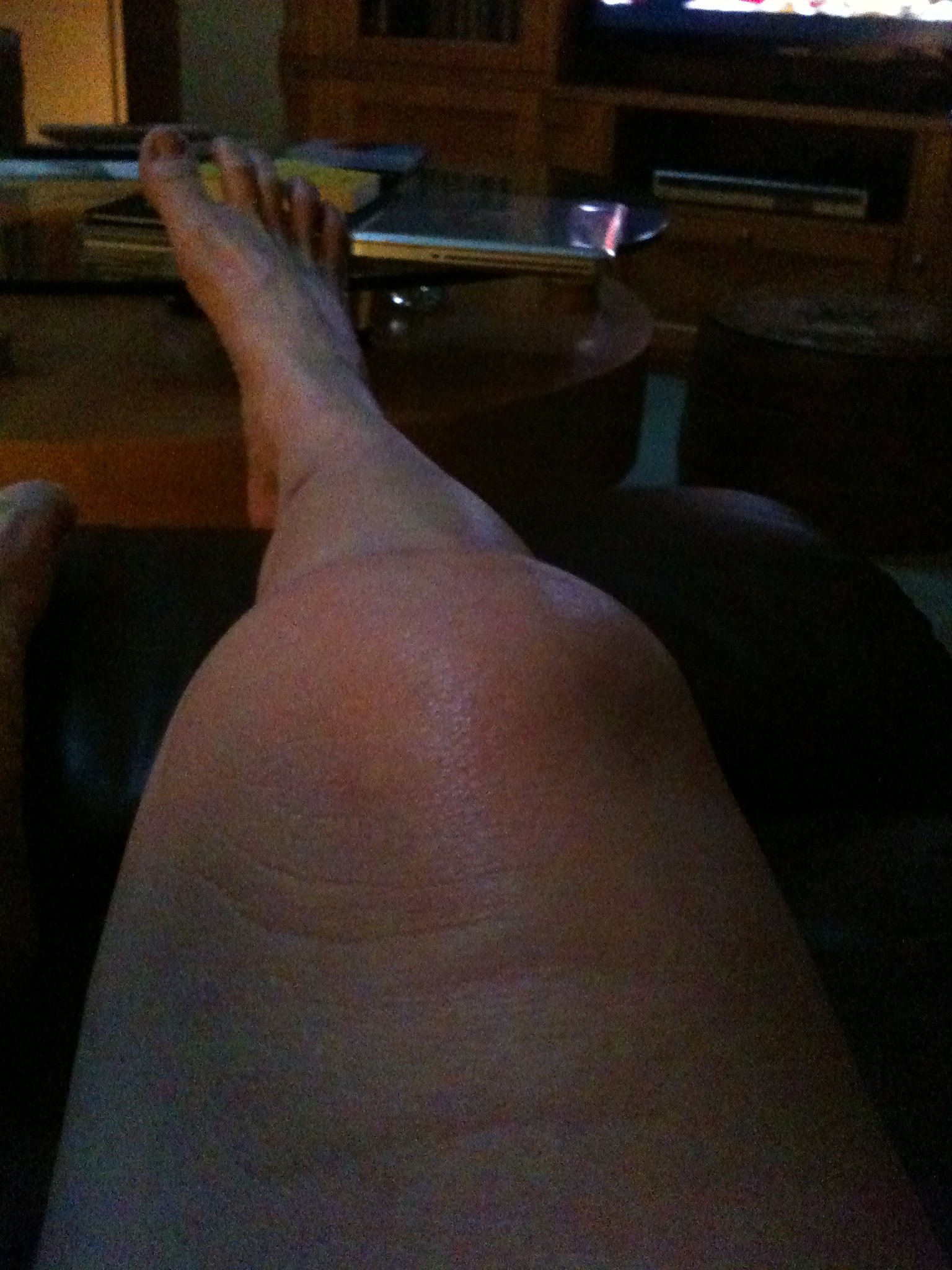
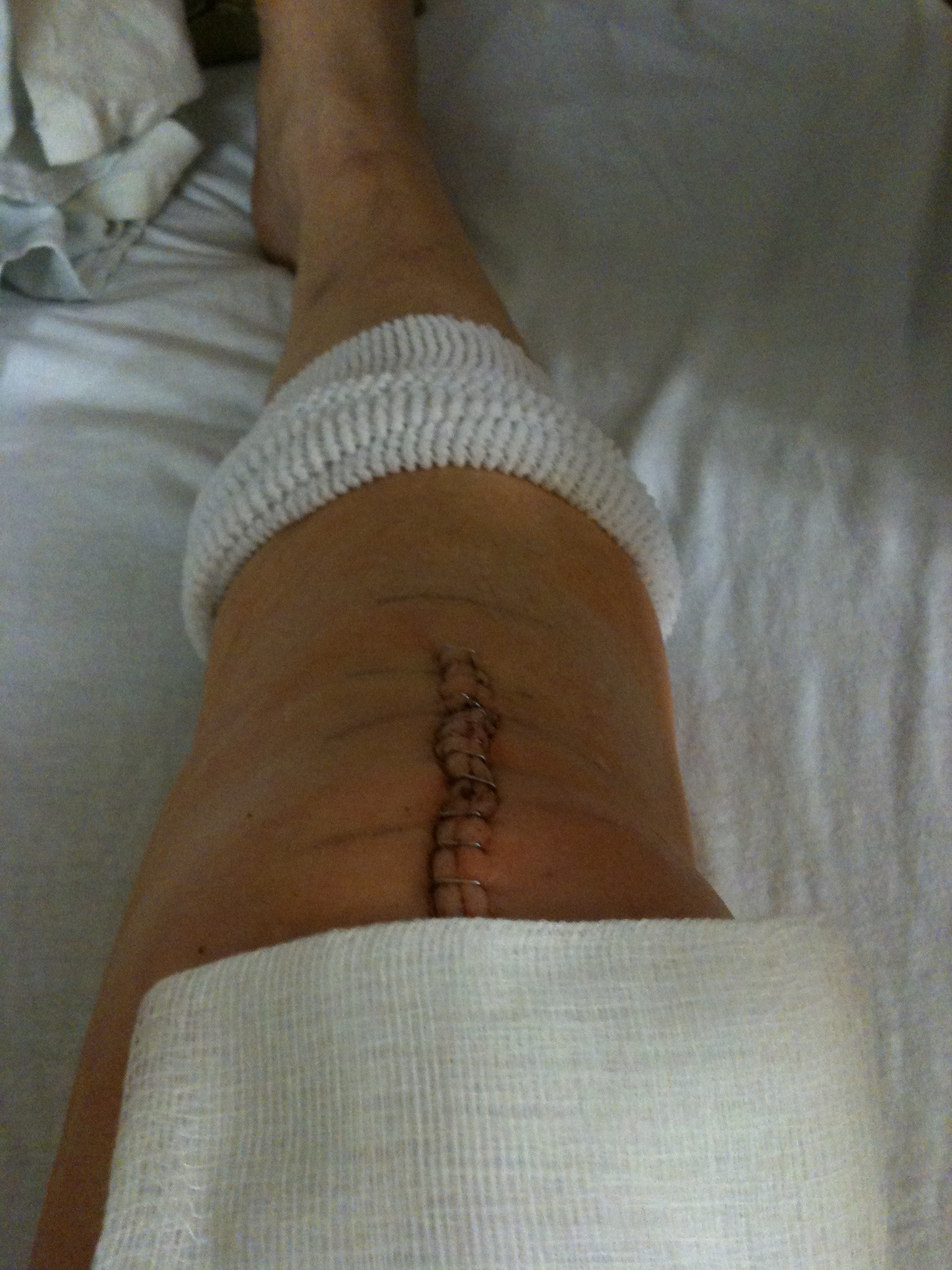
Joining the ranks of bionic-boomers, I had a partial knee replacement in April. It’s all the rage according to the press. In the weeks leading up to the surgery it seemed as though every rag or mag I picked up had an article about baby boomers “demanding” knee, hip, or shoulder replacements. As has become typical with such stories, baby boomers were cast in the role of selfish, reality-denying individuals who get what they want and won’t take “no” for an answer. Typical of the tone in such articles is the following, “Across the United States, baby boomers’ passion for competing in marathons, triathlons, basketball and tennis has worn out knees, hips and shoulders in middle age. As a result, this group is undergoing joint replacement sooner to get on with their lives.”
As someone who has never competed in any of those events I find the assumption disingenuous. No doubt there are the Type-A’s who are clamoring to feel 20 again but in my humble opinion baby boomers are getting joints replaced because of a Perfect Storm of health insurance, technology, and education in the 21st Century. My knee surgery would have never occurred without those three blessed items and I’m certain many baby boomers agree.
My knee two days before surgery
My knees began disintegrating in my late 30s when I noticed a subtle grinding and occasional click. I was an avid golfer at the time and insisted on walking the course when I could. Golf is hardly the high-impact sport implied by the articles I have read. My knees disintegrated more from genetics than high living. My problem is arthritis of the kneecap, a rather specialized version of knee arthritis afflicting 8-10% of those who present with osteoarthritis of the knee. Like the charming Agnes Gooch of the delightful movie Auntie Mame when people ask what I did that caused this problem I can say simply, “I lived.” My fraternal grandmother had the same problem and my 42-year old niece is starting to notice the symptoms. For those of us with this type of knee arthritis problems come primarily when climbing stairs, hills or inclines. Squatting or getting up from chairs isn’t much fun either. Walking is doable although that was also becoming difficult as the years progressed.
I suffered with pain for many years and used conventional treatment (medication, physical therapy) to good effect but time was not on my side. Eight or nine years ago my doctor proclaimed that knee surgery was in my future. “You’ll know when,” he sagely intoned. That “when” occurred in January 2011 while engaging in the pedestrian activity of making my bed. As I pushed on the mattress with my knee (dumb, dumb, dumb) there was a searing pain that nearly took me to the ground. X-rays showed a gigantic bone spur on the top of my knee cap. The image brought to mind a Viking boat outfitted with a large battering ram because that had been the net effect. The bone spur had rammed into the soft tissue around my knee and was very effective at crippling me for several days.
This was two weeks before a scheduled medical mission to Haiti. A shot of cortisone and RICE therapy (rest, ice, compression, elevation) helped me decide that I could do the mission and I did, but not without great discomfort. There were stairs everywhere in Haiti and more than once I had to stop mid-flight because the pain was so severe. I flashed on the story that my mother would tell about Grandmother Annie hoisting herself up the stairs at night “on her bum.” My mother’s assumption was that Annie was worn out from raising ten kids and was too tired to climb the stairs but I painfully realized the truth — she couldn’t climb the stairs because it was simply to painful to do so. In Haiti I realized that Annie’s knees were now in my body.
The trip convinced me that the time had come to do something. Bit by bit I had been letting go of the things in life that I enjoyed because of the pain I experienced from my knees. Golf and hiking had slipped away and now my knees were threatening to end an experience that I had come to love, medical missions to foreign countries.
Fortunately I had the means to do something about it. Make no mistake, if health insurance, either private or Medicare, didn’t exist we would not see the baby boomers clamoring for prosthetics. It wouldn’t matter how good the technology might be, without the means to pay for it I doubt that many of us would take the plunge. My insurance company was billed $39,000 by the hospital and $17,000 by the surgeon. (The amount that was allowed by the insurance carrier was different, of course, and that’s a topic for another day.) There were numerous other charges from doctors I don’t recall seeing plus home care after surgery and physical therapy for seven weeks. Without the guarantee of some payment these procedures would not take place. No doubt there were cutting edge treatments in Annie’s day but there was no money to pursue them and Medicare was only a dream.
The third factor of this Perfect Prosthetic Storm is education. Baby boomers are highly educated and the tools at hand are extraordinary. The internet provided not only endless articles on knee surgeries — both technical and general — but it also provided the means to compare physicians and facilities, at least here in the State of Florida. During one of my endless Google searches I came across FloridaHealthFinder.gov and found a treasure trove of data that was invaluable. Much to my delight I was able to find a section at that site entitled “Hip and Knee Replacements” and it gave comparisons of doctors (number of surgeries performed broken down by facilities). If you’re having a knee replaced do you want a doctor that has done 40 in the last year or 160! Another site was able to tell me if registered doctors had been sued for malpractice or any other legal action. Armed with this education I was confident going into surgery and this, I believe, contributed to its success.
The bionic knee, four days after surgery
And if I needed any further evidence of the importance of all this web searching in reaching my determination it was provided to me on my last day of physical therapy. The closing 15 minutes of each session was spent on a table with an ice “blanket” wrapped around my knee. Cold water is pumped through this high tech blanket and light compression applied to the knee. On this last day I had company on the neighboring table, a rather frail late-70s-something lady who I had frequently seen during my six weeks of sessions. She was not having a good day and I noticed that she seemed less competent than she had been in previous sessions. Her therapist noticed too and had her get on the neighboring table so he could “have a look at your knee.” Whatever he saw was enough to shift him into action. He placed an “ice blanket” on her knee and told her to “relax while I try to reach your doctor.” We started to chat and she relayed the sad story of her knee surgery. She was in her third month of PT, I was in my sixth week and graduating. She wished she could “walk as well as you do.” I tried to be encouraging but as she chronicled the problems following surgery — a blood clot, hematomas, a trip to the ER after she was released to home, weeks of pain — it was hard to be a cheerleader. But what made it all the more chilling to me was her doctor. You see, her surgeon had been my doctor for eight or nine years. It was he who had sagely intoned, “You’ll know when.” And when I did know when I was prepared to go with him to the operating table. After all, I had been treated by him for all that time and he is a nice guy. But after I returned from Haiti and met with him specifically to discuss surgery things began to change. He dismissed any consideration of a partial knee replacement and went a step further declaring that my left knee was “about a year behind my right” so I might want to consider a bi-lateral knee replacement. Gulp!
I left the office shaken but still with confidence in my doctor. A friend encouraged me to seek at least a second opinion and it was her encouragement that sent me back to my internist for a referral to another surgeon. With the help of the internet I was able to compare doctors and, in the final analysis, there was no comparison. The new surgeon with whom I consulted saw what the first surgeon didn’t, arthritis that was seemingly confined to the kneecap. He recommended a partial replacement, on one knee, with the option to do a total knee replacement if warranted. It wasn’t. He did the partial, which took him about four times longer than a total knee replacement would have because the partial replacement must be fitted to existing knee components, a total knee is just it says, a total knee. I’ve been told that some surgeons can replace a total knee in about twenty minutes.
But I’m lucky. I have probably 95% of my original knee, and, as my surgeon said, “God makes better knees than I do.” My recovery has been excellent and even though there is still some tenderness I can walk up stairs with much less discomfort. Oh, and there was no sign of deterioration in the other two compartments of my knee.
So, through a Perfect Storm of health insurance, technology, and education I am looking forward to a better life, happy with the simple joys of climbing stairs and being out of pain. This bionic baby boomer is, once again, grateful to the times in which she lives. ❧
The evening news gave me two reasons for optimism tonight. Oh, there was some awful news, as usual — Greece is spiraling towards collapse and threatening to take a lot of the Western world with it. In Afghanistan the outgoing ambassador took the war-ravaged country to task for not being grateful enough, a reasonable assessment given our $2 BILLION investment PER WEEK! How long can we maintain that and fix things here at home at the same time?
But two items caught my attention and gave me reason to hope. First, laws governing mortgages for first-time buyers are about to change. The new regulations will insist on 20% down and the mortgage payment cannot be more than 36% of the buyer’s debt ratio. What does that mean? Quite simple, your monthly mortgage payment cannot exceed 36% of your combined monthly payments for your car, credit cards, utility bills, and anything else.
As the song says, “Everything old is new again.”
When my husband and I bought our first home in 1984 this was very similar to the regulations that were in place. It was not a requirement to put 20% down but if you did you avoided mortgage insurance which was expensive and a hassle. We had to borrow money from dear friends to meet the magic 20% but we made it. And the percentage to debt ratio was then 35%. I recall being annoyed about that and was convinced it would sabotage our chances. But we got our loan and our $600 a month mortgage.
A reporter tonight interviewed a realtor who applauded the moves. She stated that during the real estate boom the percentage to debt ratio could be as high as 64%. Essentially that means that for every $100 dollars you make, $60 could be obligated somewhere else leaving $40 per hundred to go your mortgage payment and pesky things such as food and gas. Not much breathing room…as a lot of people have found out. Another recent news story featured a couple in California who bought a $750,000 home. He was a fireman, she a secretary. He became disabled and now they are in default, their house worth less than half of what they paid for it, and who is to blame? Well, they blame the system and I suppose that is reasonable. But isn’t it also reasonable to ask how a fireman and secretary thought they could afford a $750,000 house?
Well, I’m not here to play the blame game. This is my cock-eyed optimist blog and I am optimistic that lenders will have some tools in their quiver to look at a couple and say, “Gosh, maybe you need to re-look at how much you can afford.”
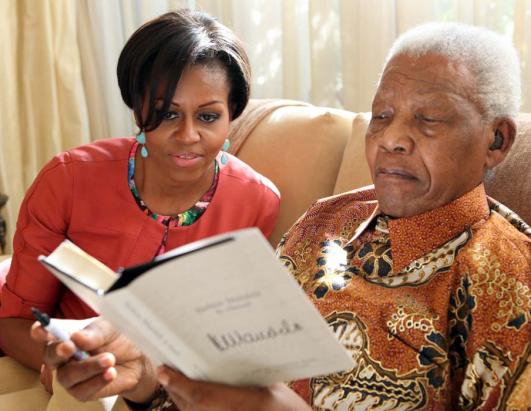
Michelle Obama and Nelson Mandela at his home in South Africa
My second optimistic moment came when this picture of Nelson Mandela and Michelle Obama was shown. Look at these beautiful people. Mandela is 92 and has lived to see the fruits of his labor harvested again and again. The First Lady, with her beautiful children at her side, is only beginning to experience that harvesting but I have no doubt that her life, should she be fortunate to live as long as Mandela, will also have a long list of accomplishments. But in this moment, captured for all time, we see yet another grateful child of the global civil rights fight, paying respect and homage to a great leader. God bless him for all he has done and Godspeed to her for the promise she exudes. ❧
AIDS has been in the news lately. Newscasters solemnly declared June 5, 20011 was “the 30th anniversary of the AIDS epidemic that took so many lives and remained a mystery for so long.” Can epidemics really have anniversaries? After all, no one is really sure when AIDS began. Some link it to the Belgian Congo of the 1950s. Was Patient Zero the sailor from Norway or the Canadian flight attendant? Either way, surely that marks the “anniversary” of AIDS.
But our 24/7 news cycle does not play well with complicated maybe-this-or-maybe-that stories. So, in our typical Amero-centric fashion, we have declared the anniversary of AIDS based on a 1981 publication of the Center for Disease Control (CDC), Morbidity and Mortality Weekly Report, which reported on five cases of Pneumocystis carinii pneumonia (PCP) in young Los Angeles homosexuals. The newscasters spoke as if AIDS was a thing of the past, like D-day or even polio. The broadcasters adopted their most sincere and compassionate voices. Images of long ago demonstrations flashed across the screen, Rock Hudson’s frail countenance was seen ever so briefly, and the aptly named Magic Johnson — 20 years on in his private battle with HIV — was backdrop for the news that protease inhibitors, coupled with education on safe sex, have slowed the virus to barely a crawl compared to the horrific days of the 1980s when it seemed that HIV/AIDS would find us all.
Robert Randall – 1992
In my own world the “anniversary” of AIDS resonated more personally. It fell just three days after a true anniversary — the death of my husband, Robert Randall on June 2, 2001. Robert had AIDS. He was diagnosed in late 1994 and died in 2001. That gift of seven years was clearly the result of protease inhibitors, the AIDS cocktail, that arrived on the scene in 1995.
At the time of diagnosis Robert had just six T-cells, the immune system’s worker bees that help us fight infections of many kinds. Average T-cell count is in the thousands but HIV, the virus that causes AIDS, directly attacks the T-cells which renders the victim’s immune system vulnerable to all manner of horrible ailments and afflictions. In those early days of the AIDS epidemic it was not unusual for AIDS patients to have pneumonia, a rare skin cancer called Karposi’s sarcoma, fungal infections of every variety, and even a blinding disease called cytomegalovirus. And that is just a few of the ailments listed by the CDC. The early victims of AIDS died truly awful deaths. And to add injury to insult they were often isolated and alone, tucked away in the farthest corner of hospitals, sealed in rooms with large warning signs and attended by medical workers dressed in protective gear that rivaled the spacesuit images we were viewing in the popular movies of the time, Alien and E.T.
Robert was spared most of that. At the time of diagnosis he did have Pneumocystis carinii which the doctor treated with an inhaled drug called pentamidine. As for treating the HIV, the primary drug at that time was AZT, which fell into the category of the treatment-is-worse-than-the-disease. Robert politely declined. We had personally known many people who used AZT and, in Robert’s opinion, it had not bought anyone the additional time that was worth the punishment.
Several months after his diagnosis, for reasons that are still unclear, Robert’s gallbladder died. AIDS related? Probably not. Medication related is more likely. Either way he was gravely ill and was scheduled for emergency surgery. The gallbladder was removed and the surgeon declared he had seen nothing like it. Necrotic and pocked with lesions. Big mystery but we had no time to think about that. We were literally in the midst of moving back to Florida to be near family. Within a short time of arriving in Florida, Robert developed pancreatitis and none of the doctors could figure out why. His pancreas, normally a small organ, was inflamed to the size of a child’s football. He was in agony. All treatments failed and there was talk of “just a few days.” Finally he was placed on TPN – total parenteral nutrition. He took nothing by mouth for three months and received all of his nutrition through an infused bag of vitamins, saline, and lipids.
It was the emerging internet that finally solved the puzzle. I found a study which stated that in an exceedingly small number of cases pentamidine — used to prevent PCP from recurring — could cause pancreatitis. In retrospect it was probably what killed his gallbladder.
Our book, published in 1999.
It was a long fight back from the pancreatitis but when he arrived there was new hope. The AIDS cocktail had arrived and Robert, having stood on the precipice twice in less than six months time and looked into the darkness of death, was ready to give it a try. It was a good move. In the next six years we would have many happy times and we would write a book of our experiences in the medical marijuana world (Marijuana Rx: The Patients’ Fight for Medicinal Pot ).
In the end he died not of AIDS but of lung cancer. He had smoked two packs of cigarettes a day for more than 25 years. He loved his tobacco. Did the AIDS accelerate the lung cancer? Quite possibly but we’ll never know and it ultimately doesn’t matter. Robert is gone. I’m certain of that and I know the precise date and time. Anniversaries are good in that way. ❧
Recently my niece’s mother died. You can see her in the forty year old picture to the left, holding my niece who, obviously, was a toddler at the time. Also in this photo is my niece’s father (my brother) and her Great-Great Aunt, who was born in 1885 and was about 84 years old when this picture was taken. Of the four only my niece remains. Her mother and father died relatively young, each in their late 60s. Her Auntie lived to be 92.
A famous poet once noted that “any man’s death diminishes me because I am involved in mankind; and therefore never send to know for whom the bell tolls; it tolls for thee.” Lofty words and quite true. But there can be no question that some deaths are harder than others and the death of a mother is devastating. Oh, life goes on and most of us are able to function following this inevitable life-event. But something changes. It doesn’t matter how old you are, how close or estranged you might have been, that first realization that you are without Her is a moment of inconsolable sorrow and you become a different person. You are an orphan.
Cut adrift, without the anchor of a mother, we move on and we re-assess our lives. This is where my niece now finds herself. Or at least that is the impression that I have taken from an email that she sent to a half dozen family members in which she shared some personal feelings about her mom’s passing, her love for her family and then asks each of us:
What is life all about?
What is most important to you?
What have you learned to be true?
I immediately responded to my niece that I would like some time to think about these questions but wanted her to know that I understood the pain and sorrow that was no doubt at the root of the questions. It is just over two weeks since her mother’s death and I know, from both personal and professional experience, that two weeks is not enough time to fully process the death of someone so dear. In my work as a hospice grief specialist I deal with bereavement on a daily basis and see every imaginable reaction to it. My niece’s reaction — to question the meaning of life itself — is not uncommon. What is uncommon is her openness in asking such weighty questions. I credit her mother with giving my niece the confidence to ask these things. Too often I see the bereaved struggling with these very same questions but completely unable to articulate them because family or society deems such questions as “silly.” Just the opposite is true but our culture, for the most part, gets a bit squirrelly when asked “What’s it all about?”
So, dear niece, I will try to answer your questions. I’ve chosen this venue for several reasons. It’s a new “blog site” and needs some “meat” which your questions most certainly provide. It’s a public forum (which I hope you don’t mind) and I like bringing this type of dialogue to the public. Who knows, maybe someone else will chime in with a comment or two. And perhaps, in the future, we can re-visit this blog page and these questions to see how our views may have changed and where our lives have taken us.
Because life is most certainly a journey and that is my answer to your third question: What have you learned to be true? I have learned that life is a journey without maps, MapQuest or any other handy guide except the God-given gift that resides between our ears. There are some who might respond that religion gives us the road map for our lives but I have also learned that religion is man-made and therefore suspect. Faith, on the other hand, seems instilled in us from the moment of conception and can, I believe, be a guiding star. Like the North Star, faith can be true but faith is also vast and multi-faceted. Our hearts and minds must always be open to absorb the changes that our life journey gives us.
It is those changes that are the answer your first question: What is life all about? Life is about constant change. Indeed, the only constant in life is change. It is the one thing you can count on which is why living for the moment becomes so important. I love the expression — “New York minute.” That’s what life is, a “New York minute.” Some will say a minute is a minute, quantifiable and steady. But in the vast continuum that is our universe our time here is even less than “a New York minute.” So, live large! Be bold! Know that the universe is our home. Gaze at the stars and know that you are a part of that greatness. As a wise woman once said: We are star-dust/We are golden/We are billion year-old carbon.
I’ve saved the hardest for last: What is most important to you? For me there is no single answer to this. My family, and by extension the friends that I love so dearly, are very important to me. Robert was most important to me and in some ways he continues to be. But your question suggests a time frame of “now” which is, in fact, the answer. This moment in which I am writing to you is the most important thing to me. And, in a few minutes when I finish and move on to my next project, that will be the most important thing to me. You are a smart lady and you catch my drift. The only thing that I really have is now, this time, this moment and that makes it the most important thing to me. It may sound like a lot of hippie-dippy stuff to some folks but it is true for me. The hardest times of my life have been when I have moved away from this philosophy, times when I get too anxious about the future or the past. Of course each of these time frames deserves attention but they are not the most important. It’s the iconic “BE HERE NOW” and it works.
So, there you are. My answers to your three questions. I hope that your request has brought you what you are seeking. And remember, your mother has become part of the star-dust once again. She is shining in her new existence and will always shine for you. Just remember to look up. ❧
The spider is at the center of this intricate web with its zig-zag design.
My backyard in west-central Florida is littered with spider webs right now. Things are getting out of control and community pressure will soon rain down on me to remove “those icky things.” If I don’t do it the association will have the maintenance crew take care of it. I can assure you the spiders will prefer my methodology as opposed to the take-no-prisoners tactics of the yard crew.
It’s not that I like spiders all that much but they do have a purpose. They eat all those other insects that I really don’t like — specifically roaches and mosquitos. So, I tolerate their unsightly webs and they help me out.
Besides, the webs are fascinating. So many different styles. Some are simple threads of silky rope seemingly strung with no rhyme or reason. And, of course, there is the “traditional” web that we have all seen on the cover of Charlotte’s Web. Some are dense cups silk that trap the poor insects who wander by. But the prize for artistic impression in a spider’s web must go to the Argiope family of spiders. And, while we are at it, they should also get the best costume design award.
Argiope spiders are common in gardens throughout the world and they are quite easy to spot due to their fantastic orb-web with its complex ziz-zag pattern. This web (above) was easy to spot in my backyard. From a distance it seemed as if a bit of paper had become lodged in the plants. It measured about 2″ long and about 1.5″ wide. The inhabitant was likely a female. All the reference sources claim the female is larger and this was a large spider.
Argiope spider and nest
She was very tolerant as I fussed around getting the camera set. The web was low to the ground, maybe six inches up. This meant getting the tripod in squatting mode and then inching it forward. I expected her to bolt at any moment but she tolerated me very well. And the detail of spider and web just kept getting better and better. Her black and white markings were lovely. There were touches of yellow that was almost iridescent.
The argiope appears to have a fierce face but her eyes are the four small dots at the base of her body.
She was such a poser that I had time to get my Tamron 90mm macro lens and that’s when she really came to life. Turns out she a face that only a mother could love. She’s a hairy little thing. But the face is a trick. Those two “eyes” are not eyes at all. She actually has four eyes (no, not glasses) and they are just beneath her furry “face” right above her pincers.
As I got closer she would start a bouncing motion that would vibrate the web and was, no doubt, an alarm directed at this weird beast that was moving towards her. After all, who knows what she seeing.
Backyards are great places for nature photography. There will be more accounts about my backyard in this blog. I hope you enjoy them.
Tell someone you work for hospice and you’re likely to get one of two responses. The most frequent is, “You people are angels! I don’t know how you do what you do but God bless you for doing it.” This is normally followed by “My mother (father, husband, brother, friend) was in hospice and the care they got was wonderful….”
The second reaction is, “Wow!” followed by a slight but perceptible shift in the room temperature to a cooler setting and a discomfort that generally stems from a reluctance to discuss any aspect of death or a bad experience with hospice. It is normally the former but it can be the latter. People do have bad experiences with hospice which is truly a sad thing to say because death, I have learned, is a wondrous thing and to participate in the passing of someone from this world to the next can be a beautiful and positive thing.
Part of the reason I have started this blog is to share some of my hospice experiences.When I share them verbally with family and friends there is always a sense of wonder and amazement at the work that I do. More than one person has said, “you should write a book”. Perhaps, one day. For the present time we’ll start with a blog.
I presently work as a grief specialist — a counselor of sorts. I’ve had this job with hospice for about one year. Prior to that I was a hospice house nurse for four years. I truly loved that job but as I start cruising through my 60s I find that 12-hour nursing shifts are harder and harder. My current job allows for the same satisfaction of helping without the physical demands of nursing. Win, win.
It’s Day 2 with my new WordPress account and, as the saying goes, there is a learning curve. I’ve been struggling with efforts to load WordPress on to my Mac in order to work offline with developing pages, posting pictures, etc. But the fact of the matter is that I don’t need to do that. Obviously I can write and post from within WordPress online. So, the goal is to follow some advice that I learned a long time ago while working on a children’s play, “Don’t try hard, try easy.”
It’s good advice. Humans very often try too hard when easy will do just as well. Obsessive to a fault we simply lose sight of the objective and become very entangled with details. So, stepping back for a moment, I asked myself “What is the objective?” Am I trying to learn Apache and MySql? Do I need to revisit the world of HTML and FTP? I’ve been there before and it is all very fascinating. But what is my objective now?
The answer is to learn a bit about WordPress and see where it will take me. For years I have posted on my iWeb account. After struggling in the early days of web site construction (late 1980s and early 1990s) I was delighted as programs emerged that simplified the process of posting a page on the Web. Microsoft’s Publisher was a huge advance at the time and allowed me to construct a relatively complex website for the non-profit organization that my husband and I founded in the early 1980s — Alliance for Cannabis Therapeutics (ACT). More on that story another time.
After my husband’s death in 2001, I switched to the Mac and the wonderful world of iLife and its various components. iWeb was (and is) a wonderfully easy web page development program. But over time I became disillusioned with its limitations, especially with respect to photographic pages. I wanted something that I could post to easily and quickly. I wanted something that will allow me to combine my two loves — writing and photography. I’ve heard that WordPress might be the place.
Time will tell. For the next few days (and maybe weeks) my plan is to “play” with this site. Get some folks to follow the postings and let me know what they think.

 So, it was with complete and utter amazement that I found a dead hummingbird in my front yard. I caught a glimpse of his tail feathers and dismissed it as a mushroom but something made me turn back.








 Alice's WanderLand