Image #201 – Cold Cattle egret

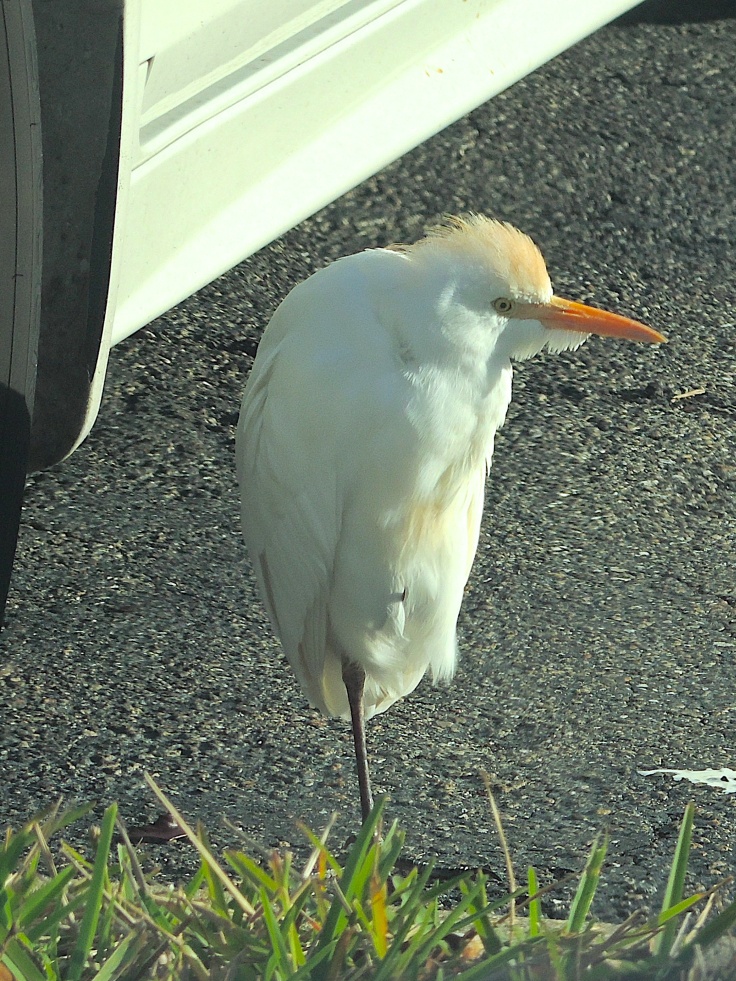
Cattle egret (Bubulcus ibis)

One of my favorite “Florida birds” is the Cattle Egret.  I put that “Florida birds” in quotations because this bird is in no way exclusive to Florida. It is found just about everywhere on the globe, rather like the Great Blue Heron. It is thought to have originated in Asia which is a long way from Florida. But I associate this bird with Florida because it was so ubiquitous when I was growing up. In those days Sarasota County had lots of pastures and lots of cattle. These little beauties were always in evidence. Sometimes they would be perched on the cow, picking bugs from the cow’s back or up near the cow’s ear. The cows seemed content with this arrangement and why not? Florida bugs can be very irritating.

This particular Cattle Egret was a long way from a pasture (although several decades ago it was grazing land).  It was in a parking lot, using a car as a wind shield. The wind was wicked yesterday and it was cold by Florida standards. This little guy was smart to take a breather — on the leeward side and in the sun.  When I looked up Cattle Egret on Wikipedia the entry stated, “The Cattle Egret (Bubulcus ibis) is a cosmopolitan species of heron …” Too right! ❧

Image #198 – The snow is coming, the snow is coming

Northern Cardinal (Cardinalis cardinals)

I never tire of these guys (and gals). Cardinals are a special bird.  “Winter’s flowers,” as one friend said. They have so brightened my days. This particular fellow was digitally captured during our recent snow storm. Another is forecast for this week…8-12″ are predicted.  I hope to be far away by then. I am throwing in the towel and fleeing to Florida for a few weeks. There is plenty I can do there.  If I stay here I can watch the Cardinals…which isn’t a bad thing…but life is short and it is best to make hay when the sun shines. The Florida Supreme Court has ruled and medical marijuana will be on the ballot in November 2014. I plan to do what I can to make sure that it passes. Stay tuned.  ❧

Image #197 – Goldfinches

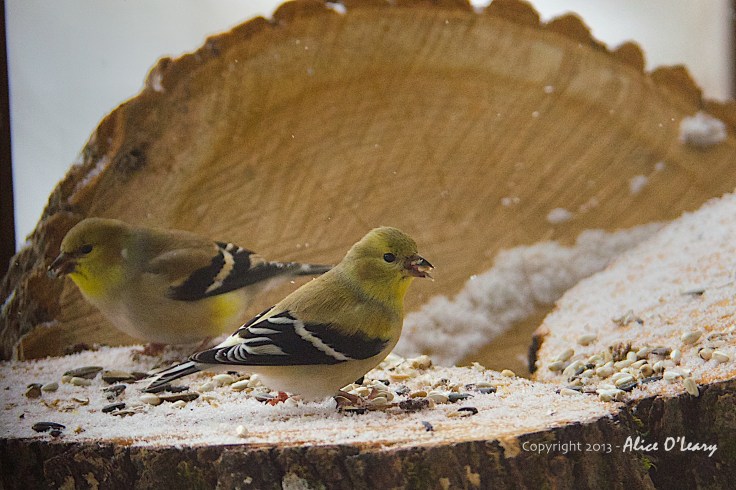
American Goldfinches
American Goldfinch (Carduelis tristis)

More bird pictures from last week’s snow storm. These American Goldfinches are showing their spring and summer coat of bright yellow feathers…more indication that spring is on the way.  Just a few weeks ago they were so drab, almost olive green.  It is a complicated bird according to Wikipedia:

“The American Goldfinch undergoes a molt in the spring and autumn. It is the only cardueline finch to undergo a molt twice a year.[14] During the winter molt it sheds all its feathers; in the spring, it sheds all but the wing and tail feathers, which are dark brown in the female and black in the male.[13] The markings on these feathers remain through each molt, with bars on the wings and white under and at the edges of the short, notched tail.”

Surely not ALL of its feathers? Can’t say that I have seen one naked American Goldfinch and I think he/she would stand out in a crowd. 🙂

Image #196 – Eastern Towhee (Pipilo erythrophthalmus)

Eastern Towhee (Pipilo erythrophthalmus)

A good snow fall, like the one we had last week, brings many birds “out of hiding.”  The Eastern Towhee is one of those birds. Throughout the months that I have been here I would catch a glimpse of the Towhee, normally its backside, frittering about in the underbrush but rarely did I have a chance to study this beautiful bird. The snow changed all that. This fellow was grateful for the scattered seed on the porch as well as respite from the wet underbrush. I have now learned that Towhees are part of the sparrow family and it is wide-spread throughout North America. And apparently I am not alone in my inability to study this bird. According to Wikipedia, “The taxonomy of the towhees has been under debate in recent decades, and formerly this bird and the Spotted Towhee were considered a single species, the Rufous-sided Towhee.”  ❧

Image #194 – Sisters in the snow

Two female Northern Cardinals (Cardinalis cardinalis)

Two female Cardinals during our recent snowstorm. I have quite a flock of cardinals: two, possibly three males and at least four females. ❧

Image #193 – Dark-eyed Junco

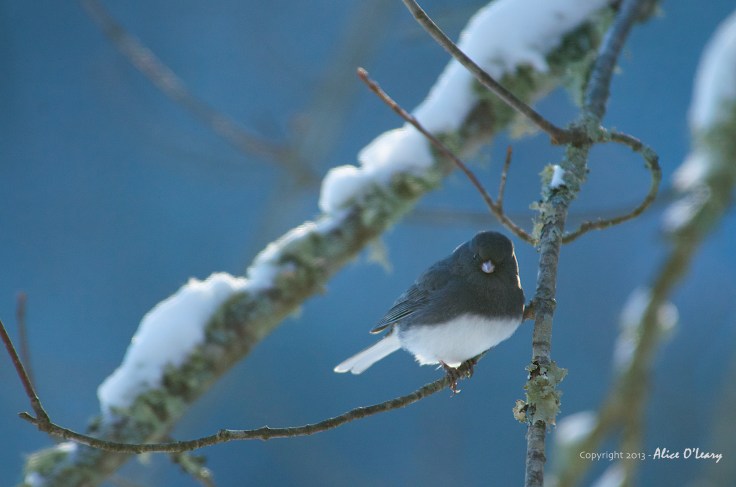
Dark-eyed Junco (Junco hyemalis) - Slate colored
Dark-eyed Junco (Junco hyemalis) – Slate colored

The snow and clear, arctic air have combined to give absolutely gorgeous lighting for my bird shots. This Slate-colored junco has some beautiful highlight on his brilliantly white underside and all thanks to the snow. Had I walked outside and placed a spotlight I could not have done it better. ❧

Image #192 – Practical or Greedy?

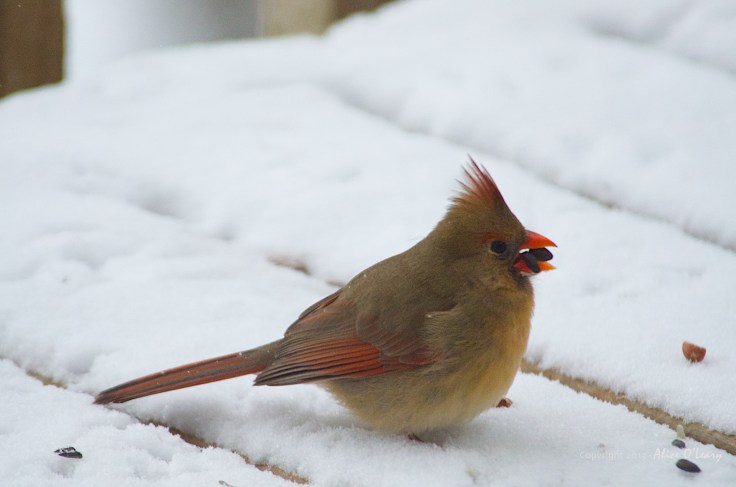
Female Northern Cardinal (Cardinalis cardinalis)

I think practical.  The bird seems young and it is probably her first snow fall so why not take as many seeds as the beak will hold?  ❧

#187 – Got Your Back

Image #187This sparrow, I think it is a White-crowned Sparrow, landed on the handrail of the deck near my gargoyle. During this frigid weather, that has seized most of the nation, the birds are flocking to my feeders in great numbers.  Normally there are waves of birds who will all fly off at once and leave the feeders empty for a while. Now, however, it seems the feeders always have visitors. Some look very ragged and I wonder if they will make it through the night. The wonder is that any of them make it through this cold. ❧

Image #174 – Toulouse gosling

Toulouse goose gosling June 2010
Toulouse goose gosling
June 2010

Here’s another shot from  my encounter with friend Mary’s Toulouse Geese. This gosling is being held be Mary. Don’t let the shyness fool you. They arrive hard-wired to take a bite of you.  In fact, this one was probably about to take a bit of Mary’s hand. 🙂  ❧

Image #173 – Grieving Geese

Toulouse goose (gosling)
Toulouse goose (gosling) – June 2010

My friend Mary is mourning the loss of her male Toulouse Goose. His name was Doodle and he was twelve.  Three and a half years ago he fathered several goslings and I was fortunate enough to get their pictures.  Doodle is survived by a mate and two daughters who are greatly grieving his loss.  Mary wrote on Facebook,

After 12 good years of life he has passed over the Rainbow Bridge. If dogs and cats can go over, why not a much loved goose. His much younger mate and their two daughters are very lonely without him. If anyone has or knows of anyone within 100 miles of Sarasota, Fl who has geese please put me in contact with them. Many thanks.

The new male has big wings to fill. Doodle was an excellent protector and, of course, had been with his ladies for many years. Change is hard for all of us mammals.  I certainly wish the survivors well.  ❧

Blog at WordPress.com.

Up ↑