Image #148 – Putting on a new coat — seasonal changes in the bird world

Image #148

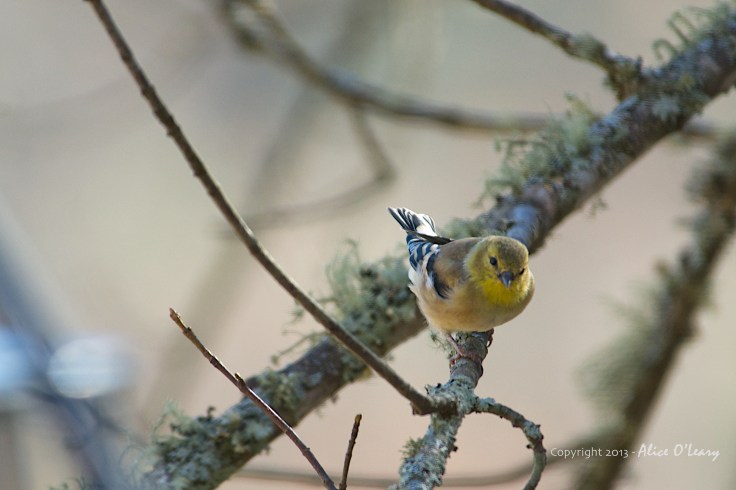
Previous posts have included pictures of the American Goldfinches who have graced my feeder throughout the summer (Image #141).  Now it is mid-fall and  mating colors are gone . I learned today that the American Goldfinch is the only finch to undergo a complete moulting process.   So the bird in this picture could be the same as the bird in Image #141.  But American Goldfinches are also migratory so this may be an entirely different bird.  This bird, according to The Sibley Guide to Birds, is a an adult, non-breeding.   While not as dramatic as the male American Goldfinch in his mating finery he is still a very handsome bird. ❧

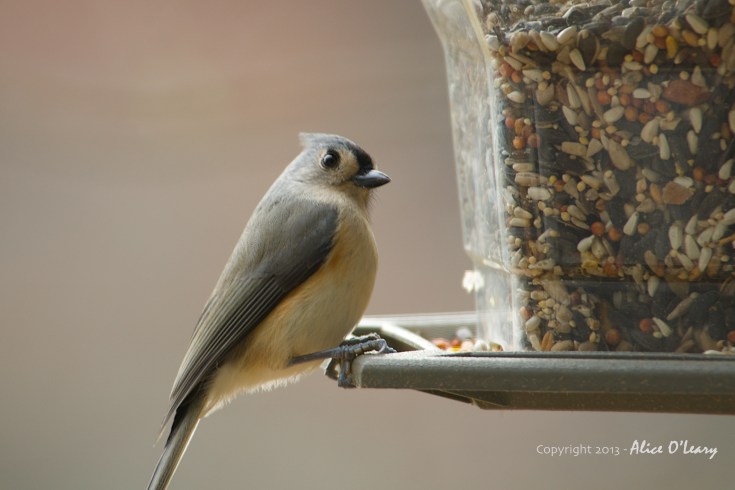
Image #146 – White-breasted Nuthatch

Image #146

The variety of birds at my feeder has narrowed to about 6-10 varieties. The White-breasted Nuthatch is one of them and he is a surprisingly cooperative subject. The Titmouse and Chickadee are frenetic and move too quickly to grab the right focus. But this little fellow looked right at the camera and smiled.  Don’t you agree? ❧

Image #145 – Carolina Chickadee

Image #145

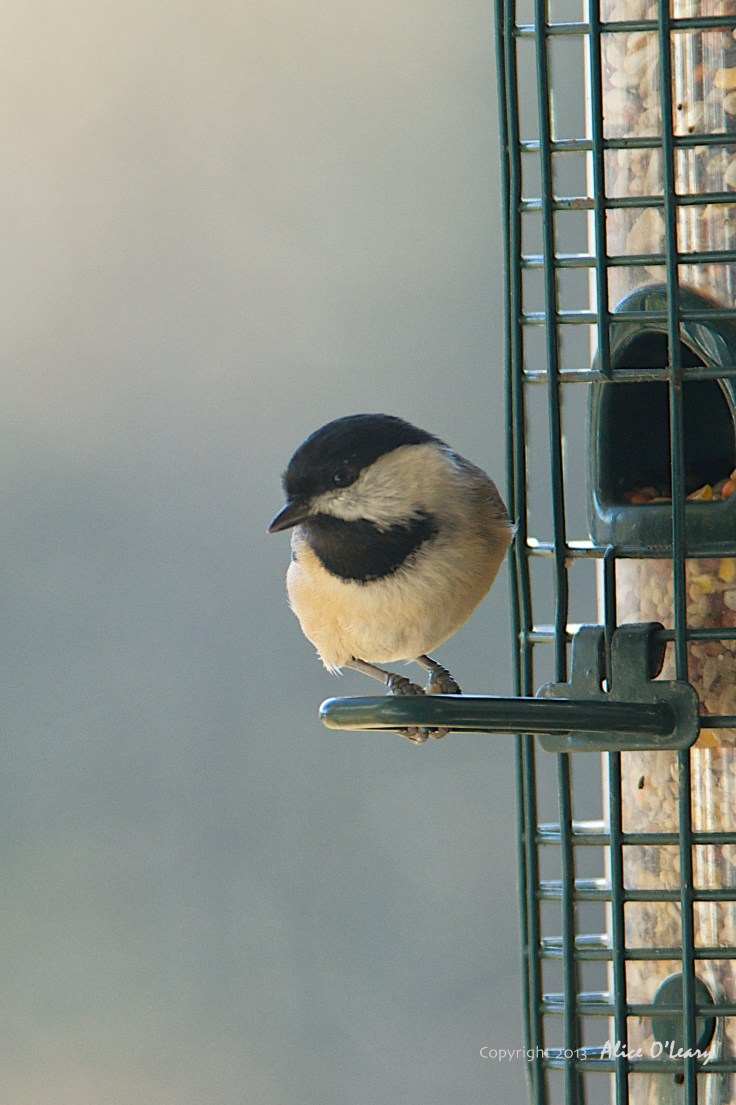
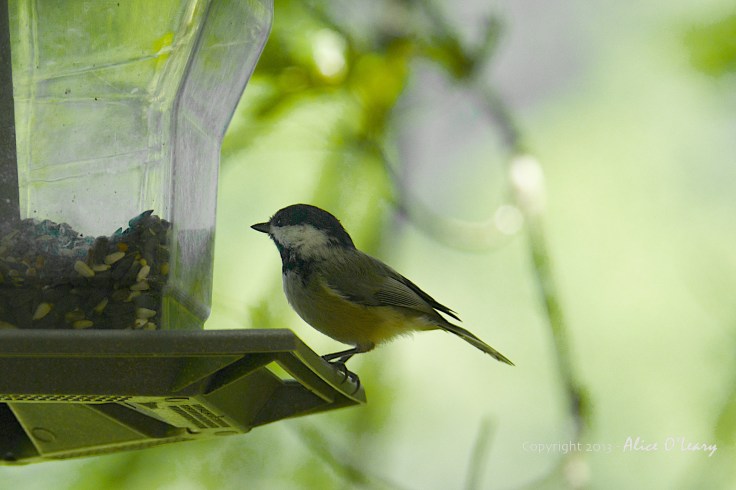
A sweet Carolina Chickadee at my feeder. Carolina Chickadees are a bit smaller than the more common Black-capped Chickadee.   They are part of the same family as the titmouse, which might explain why they “hang” together.  The two seem in constant company with one another.  They constitute Paridae, a large family of small passerine birds, which you can learn more about by clicking on the links.  They do not migrate south which means my feeders will continue to enjoy their presence throughout the winter.  And that will be just fine with me. ❧

Image #141 – Juvenile American Gold Finch

Image #141

The babies have fledged and are on their own. This is a Juvenile American Gold Finch.  Quite possibly he is the progeny of this fellow (below).

Image 141 (1)

On Fawn Hill life is moving on …  ❧

Image #140 – Tufted titmouse

Image #140

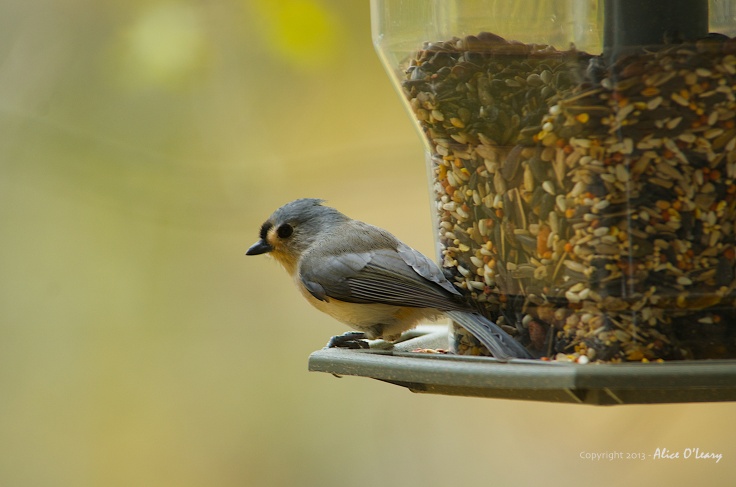
These guys are such frequent flyers at my birdfeeders. My Audubon Field Guide states the titmouse “are social birds and, especially in winter, join with small mixed flocks of chickadees, nuthatchers, kinglets, creeper, and the smaller woodpeckers.”  Well, spot on Audubon! ! That perfectly describes my feeders just now. Mix in purple finches and cardinals and you have the Fawn Hill bird mix of the moment.  I’ve been told that juncos will arrive  but I remember in Washington, D.C. that the juncos arrived only when it was truly cold to the north. Perhaps the same is true here. ☙

Image #100 – Growing Up is Hard (9/6)

Image #100

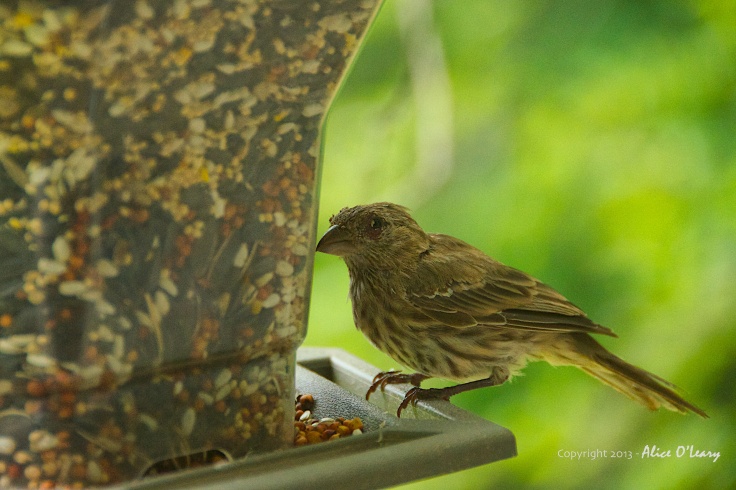
My feeders are overwhelmed with fledglings, young birds trying to learn the intricacy of living. They remind me so much of young toddlers.  Watching a toddler get command of his or her legs is not much different than watching a young bird learn how to use his wings.  They fly in and hover by the feeders, unsure how to make the final approach, often missing the landing perch again and again. Once they do find the perch they begin to eat and are reluctant to leave. They do not yet comprehend the dangers in life and the need to flee. This little fellow above is a perfect example. All the other birds flew away when I walked onto the porch, but not this guy. I was able to walk up to feeder and get within a few feet of this young finch and snap this picture. He never moved. I have literally watched fledglings fall asleep on the the feeder, their beak in the trough like a toddler asleep in his oatmeal. It’s dear and entertaining. I wish them luck but know that many won’t make it. But, then again, that is true of us all. ☙

Image #90 – On the brink …

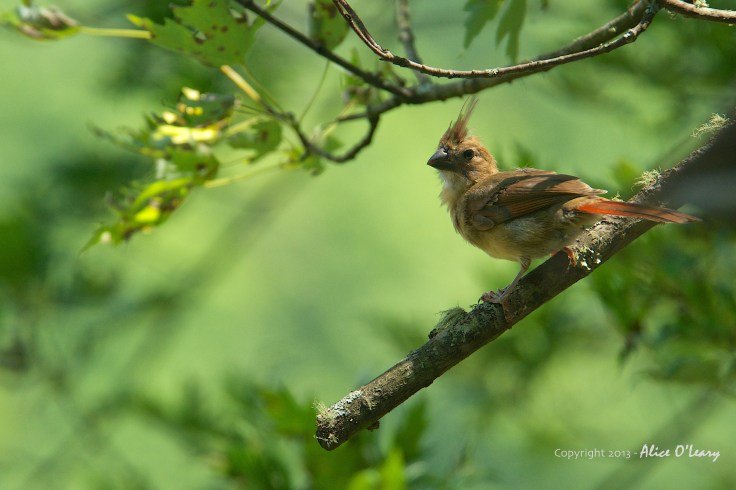
Image #90It has been a joy to watch fledglings mature to almost adulthood. This picture is a perfect example.  A juvenile, female red cardinal, I’ve watched her parents fly in and out of the feeders on an endless gravy train run of food to their chicks. Later the parents brought the young birds to the feeders where I would watch tender feedings from adults to fledglings.  Soon the parents made it clear it was time for the young ones to stand on their own and so they have.  This young female is poised on the brink of adulthood. Perhaps she’ll join a migration southward or maybe cardinals “tough it out” in the North Carolina winter. I haven’t been here long enough to know and, since I don’t plan to be here in the winter, I’ll probably never know.  We can’t know the minutiae of life’s cycle, only the broad strokes.  She is vibrant and ready to take on life.  Good luck to her. ☙

Image #89 – A simple Chickadee

Image #89Tonight’s post is a simple chickadee, grabbing some chow at the feeder. Birds, if you watch them long enough, take on human qualities.  There are the flashy birds–like hummingbirds, cardinals, and buntings. There are the working class birds–the finches, doves and crows. And then there are the not-quite-flashy-but -fun birds–like the chickadee, the tufted titmouse … so many birds!  I love them all, even the drab LBJs–little brown jobbers. My late friend Susan was the first person I heard use that expression. It stuck like glue. There are TONS of LBJs–finches, sparrows, juvenile _________________ (fill in the blank). With age I have come to realize that appreciation is the key, not the species name.  Chickadees or LBJs, I love them all. ☙

Image #84 – Shelter from the Storm, Part II

Image #84

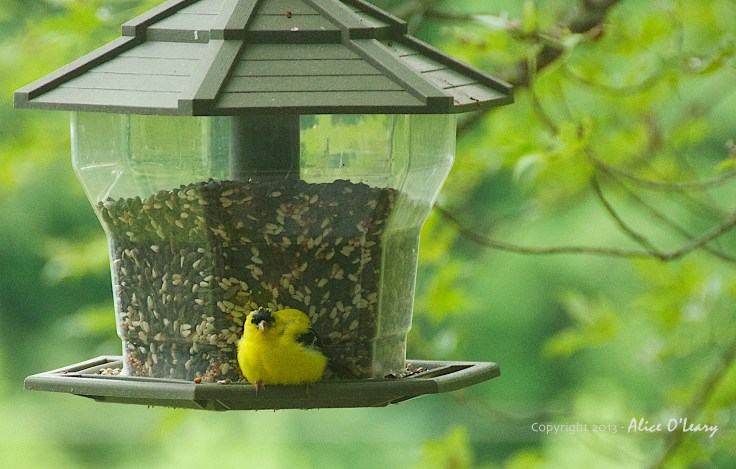
Hunkered down, riding out the storm, this gold finch barely moved for 10-15 minutes as yet another rain storm passed through. We have had LOTS of rain. The birds are fortunate that so many people feed them in this area.

Gold finches are truly spectacular birds, rather like wild canaries in their yellow-brilliance.  This fellow would have preferred thistle seed over the sunflower and safflower mix I provide.  But thistle is expensive. I recall a colleague from many years ago who could identify nearly every bird by its song. He was a terrific birder. He commented once that he didn’t worry too much about college tuition for his children but he worried about the costs of keeping the finches in thistle seed. Things haven’t changed. ☙

Blog at WordPress.com.

Up ↑