Image #264 – Indigo Bunting (Passerina cyanea)

Image #264

The Indigo Buntings are regular visitors to my feeder these days. My neighbor reports seeing them in previous years but my experience on Fawn Hill is short, just over one year, and I’m certain I did not see them last year. These birds are memorable once you see them. But they are very shy and wary of humans. No doubt they were once coveted for those beautiful feathers. Hat fashion in the early 1900s was a catastrophe for so many beautifully plumed birds.

Cool facts about Indigo Buntings (courtesy of The Cornell Lab of Ornithology): Indigo Buntings fly about 1,200 miles each way between breeding grounds in eastern North America and wintering areas from southern Florida to northern South America and Cuba.

Indigo Buntings migrate at night, using the stars for guidance. Researchers demonstrated this process in the late 1960s by studying captive Indigo Buntings in a planetarium and then under the natural night sky. The birds possess an internal clock that enables them to continually adjust their angle of orientation to a star—even as that star moves through the night sky.


Image #261 – A Soggy Hummingbird

Image #261


A soggy hummingbird gives me the eye during our two days of constant rain. Thankfully it was constant and not torrential but it was seriously constant and it made it tough for our friends who live in trees.  Where do they go when night falls?  Certainly some are minding nests and protecting young ones. Last night must have been a long one because the rain did not cease.  First order of business when the rain stopped? Off to Tractor Supply for more birdseed, of course.  ❧

Image #257 – You Gotta Break Some Eggs to Get Baby Birds

Image #257

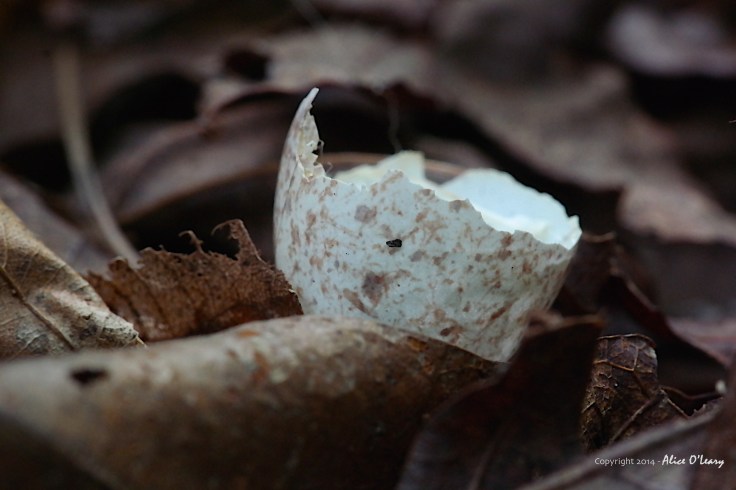
A successful birthing?  It would seem that way. The small remains of a bird’s egg graces the forest floor. Live long! Prosper! ❧

Image #254 – Indigo Bunting


Indigo Bunting (Passerina cyanea)

An Indigo Bunting, adult male. I can’t recall sighting an Indigo Bunting before this season. A friend has told me she saw one in Manatee County but I can’t recall ever seeing one before.   So, this is an extra special event. I apologize for the graininess of the image. (SPOILER: Geek talk ahead.)  I had boosted the ISO rather high in an attempt to capture images of fireflies. In my excitement I forgot to check all the camera settings. But on some levels I like this shot being grainy.  It seems more real.

At any rate, I have now identified an Indgo Bunting at the feeder which brings the “life list” for the feeder to about 20 birds…20 and hoping.  ❧

Image #230 – Caesar, the family goose

Image #230

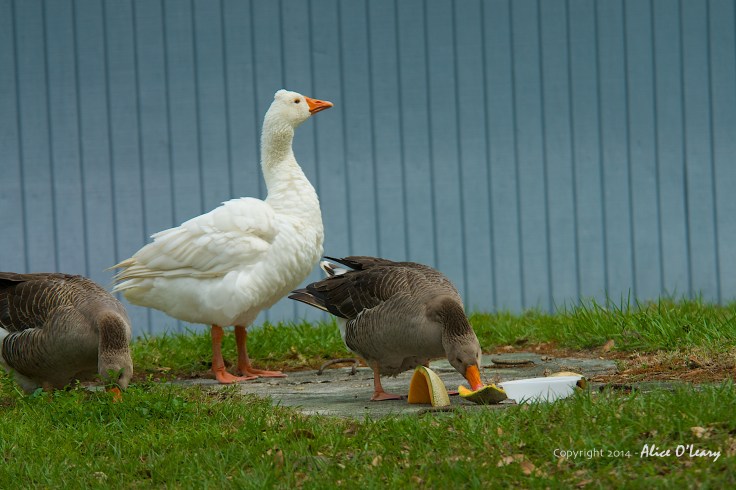
Meet Caesar, the large white goose standing between two of his harem members. Caesar is a Roman Tufted Goose and according to Wikipedia:

The Roman Tufted was developed for exhibition. Due to its small size it is not suitable for commercial meat production, but is well suited for weed control and as a table bird for small families making it good choice for a backyard flock.

“[A] table bird for small families. . .”!!?? Yikes!  Well, this particular Roman Tufted Goose does not need to worry about such a end. Caesar has landed among a harem of three Tolouse geese at Mary’s farm in Sarasota. His job is enviable. He is to provide companionship, protection and, perhaps, an heir. He is a replacement for the recently departed Doodle who was excellent in all three required areas. Mary wondered if any goose could fill Doodle’s . . . webbed feet.  Well, I am happy to say that Caesar has not only met the mark,  he has surpassed it.

When I arrived in Florida last February Mary had only just gotten Caesar and wasn’t quite sure how things would work out.  It’s the old Romeo and Juliet, Tony and Maria thing. Would Tolouse geese accept an, ahem, goose of a different color? Things were a little tense at the start but then Caesar led the gals to the pond and, well, let’s just say that geese like to do it in pond. Love ensued. Eggs were laid… 20+ eggs is the last count I heard.  Of course not all eggs breed chicks but Caesar and the girls are working on that … clearly.

But the best part is that Caesar is a modern dad. Mary discovered him sitting on the nest a couple nights ago. She was quite amazed but we all know that Romans are definite familia-oriented. He is also definitely into protection. He attacked poor Tango on a couple of occasions, nipping his back end and inflicting no pain except for surprise. Tango would run away and Caesar would puff up, extend his wings and, if he could, crow.  But geese can’t crow. They make the most awful noise and it would take one to love one. Thankfully nature, and Mary, has taken care of that.  ❧


Image #223 – Cattle Egret (Bubulcus ibis)

Image #223
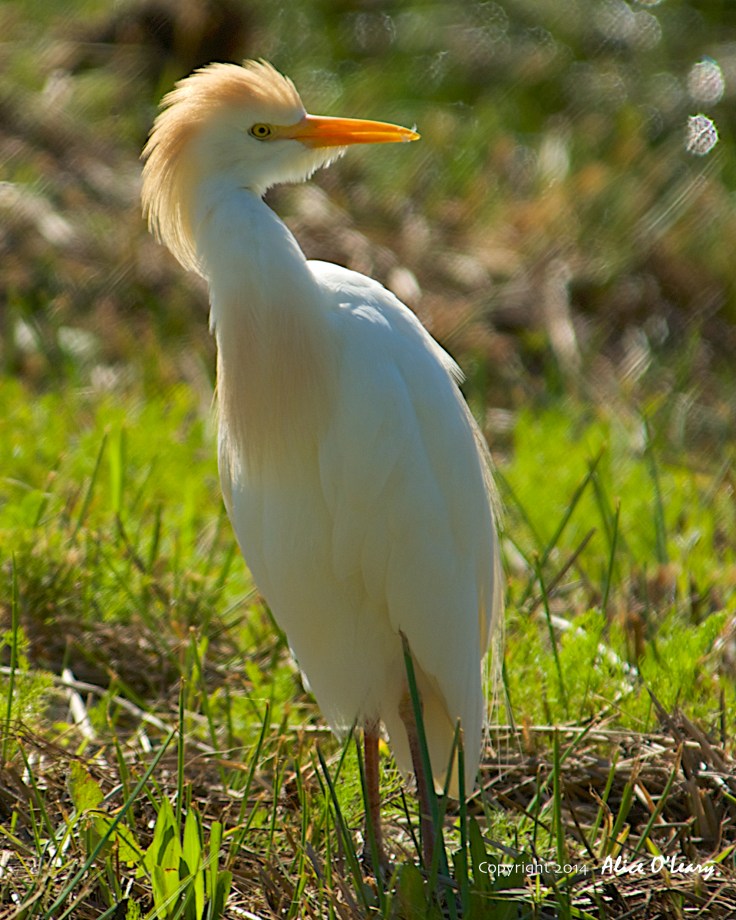
Cattle Egret (Bubulcus ibis)


A Cattle Egret. One of my favorite birds. This one has his mating feathers and is very handsome indeed. The younger ones look very punish when their  beautiful crown feathers start to fill in. They are aptly named and can often be found in pastures among the cattle.  ❧

Image #221 – Captive Bluebird

Bluebird 1

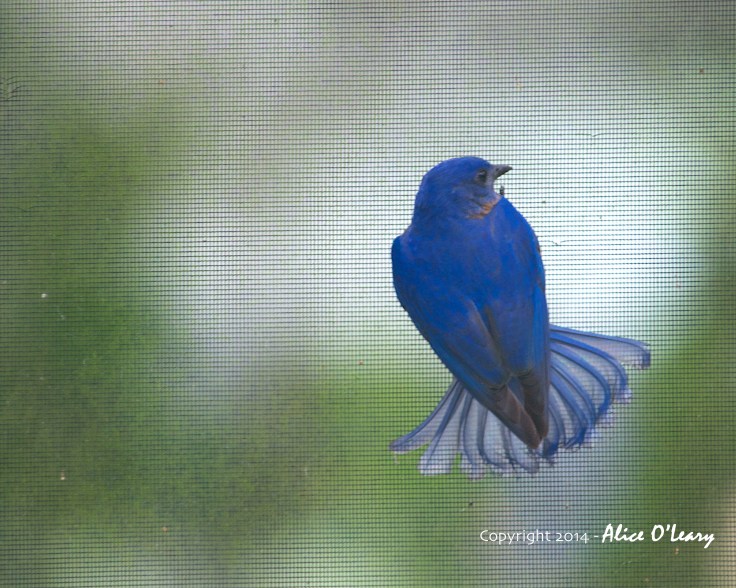
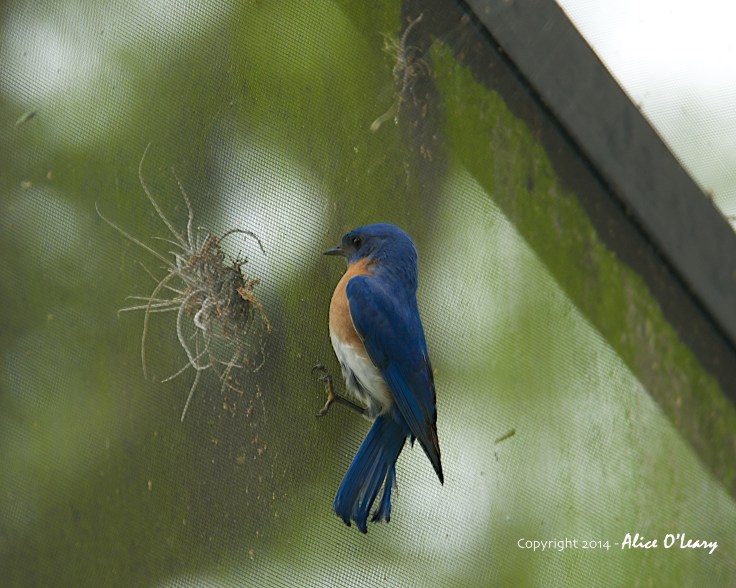
There was an unexpected visitor this morning.  A bluebird got stuck in the pool cage!  I can’t recall ever seeing bluebirds in Sarasota. The first one I saw was a couple of years ago in Laurel. But since staying at Mary’s I’ve seen several, at least three at a time.  Hard to say if it’s a family settling in or just “snowbirds.”

We aren’t sure how this fellow got into the pool cage His mate was outside calling to him and he would answer–frantic, reassuring?  Oh, to understand what birds say.

This shot displays his beautiful tail feathers.

Bluebird 2And here is a good shot of his chest.

Bluebird 3

He safely escaped after we opened the door. I saw two bluebirds about an hour later as I walked Tango. I could swear one said, “Thank you.”  🙂

Image #220 – Flight pictures

Image #220 (1)

Frequent visitors by now will have figured out that I take many pictures and only a small percentage reach this blog. I try to be discriminating but sometimes, I think, I may apply too high a standard. The picture above is a case in point. This was captured about a week ago. I was at a nearby park and saw these pretty birds “working” the area around the fence. The markings on this bird are quite distinctive but my reference resources are limited so I don’t know what kind of bird it is. Please, anyone, feel free to help me out.

When I sorted the pictures that night I lingered on this photo for quite a while because it is so dramatic. Birds are such awesome creatures of agility and I love pictures that capture their moves. I was going to post it but then thought better of it because it wasn’t “good enough.”

And then a fellow blogger — Bird Canada — posted a blog about flight and said, “in fact, a good picture can reveal things that go [by]  too quickly if you are looking at it at normal speed (even after the fact on a video).”  I immediately thought about this photo.  Yes, it isn’t as sharp as I would like but it is a good picture because of what it reveals. It has caught this bird springing straight into the air from the fence, with his wings tucked and extended all at the same time.  In the next moment, which I and the camera completely missed, he dove straight down in fast pursuit of a tasty morsel.

So, thanks Pierre for  your wonderful photo-essay.  Photographing birds in flight is not easy but even the less than perfect picture can be pleasing. ❧

Image #211 – Good Geese!

Caesar

That’s Caesar in the white wings, feeling his oats I suspect. Caesar is Mary’s new male goose, recently acquired to replace the late and fondly remembered Doodle.  Caesar has been at Mary’s for about a month. I had the good fortune to observe his first dip in the pond.  The ladies were happy to join him.  They splash about and engage in reproductive as well as hygienic activities. Mary has wondered what the geese might look like who come from Caesar mating with the Toulouse geese.  Stay tuned . . . ❧

Image #204 – Wild Turkey

Wild Turkey (Meleagris gallopavo

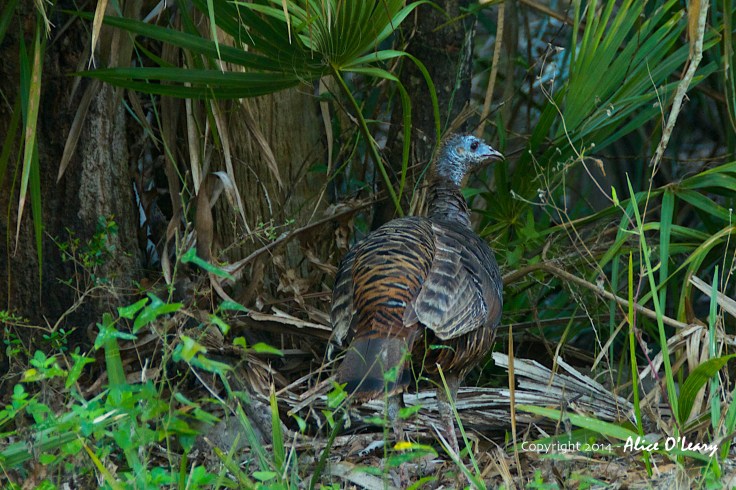
Sorry if you were expecting a blog on Wild Turkey bourbon. This is the real deal, a young Wild Turkey from Myakka River State Park. At one point in time Wild Turkeys were virtually extinct in Myakka. Hunters had decimated the abundant flocks in the early 20th Century but the bird was re-introduced and protected. It now thrives. Perhaps these birds have some genetic memory of the slaughter their ancestors endured. They are always on the move, pecking quickly at the ground, never stopping…or so it seems. It has been hard to get a good picture but this picture shows quite a bit of the beautiful coloring on these birds. ❧

Blog at WordPress.com.

Up ↑