Trying to “capture a moment” is a lot like “saving time.” We frequently use these expressions but, honestly, neither can be done. The best we can hope for is the illusion of achievement. Photography is perhaps the best tool in this art of illusion. Pictures give us the sense of freezing moments in time and their evocative nature often succeeds in transporting us back in our memories and resurrecting “that feeling.”
There is a particular grove of oak trees at Myakka River State Park. It is pictured here. I yearn to capture the beauty of it with my camera and have taken countless pictures there. It is simply magnificent, no matter the time of year or the time of day. It seems particularly gorgeous in its spring glory. So I share this illusion with you, this moment of time captured in bits and bytes. Happy spring everyone. ☙
For the last couple of weeks I have been exploring the Park outside of the Park. This is mainly prairie land located east of the main entrance to Myakka River State Park. Since I normally drive in from the West side of the Park these areas had never really registered in my consciousness. Another deterrent was a seemingly endless road repair process that was ongoing just east of the Park entrance.
In my quest for pine lillies a few weeks back, however, I followed a lead to one of these eastern gates and began wandering around. I wouldn’t want to be out there in July but right now it is very sweet. Wildflowers are everywhere in the scrub, and the wild grasses are in full “bloom.” To those who say Florida doesn’t have a colorful Autumn I invite them to visit the Myakka prairies in the late day sun. It is an artist’s palette.
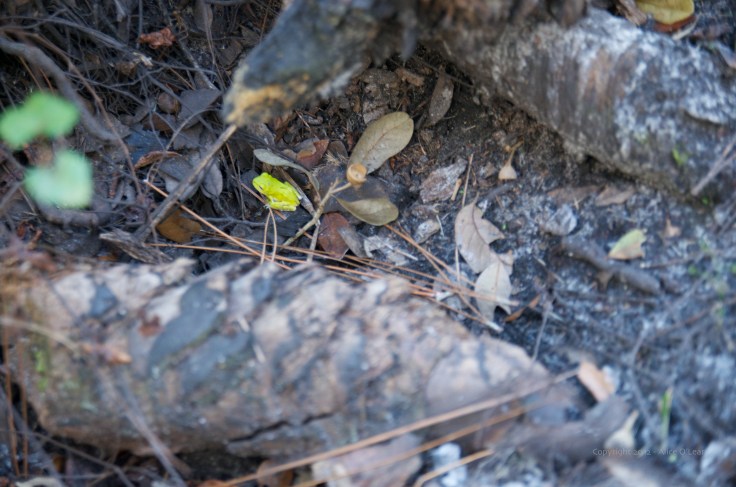
The tracks are mainly service roads but the pigs and other critters have made single tracks that lead off the roads and into the scrub. I was making my way through some of the scrub on Saturday, watching my step because the scrub roots are treacherous. From the corner of my eye I saw what I thought was a leaf falling… sideways. Whoa! Leaves do not “fall” sideways. I looked down and saw this guy.
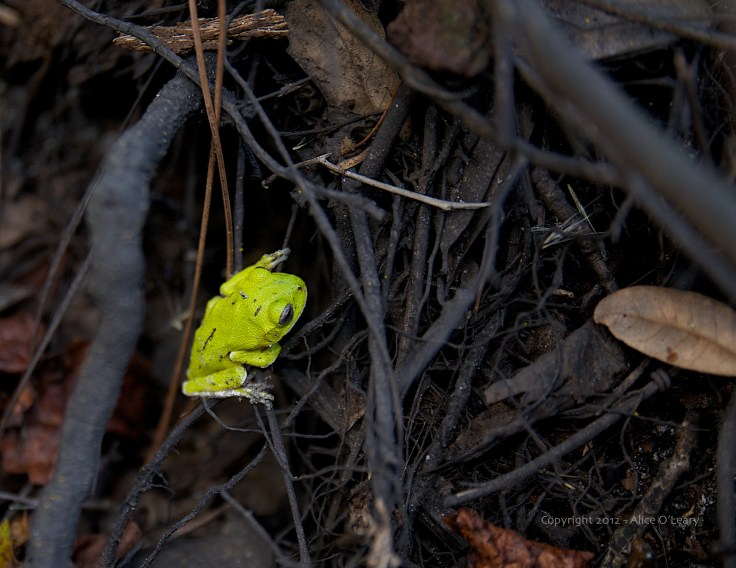
A lime-green frog! Very much the color of the scrub. He landed in a hole next to some burned scrub. Of course my camera did not have the right lens on it for this occasion but I did the best I could, absolutely certain Kermit’s cousin would take one hop and be gone.
But he didn’t. Turned out he was quite a poser but, alas, he had not chosen the best of stages. He was about 3 inches below me and there was debris everywhere. I kept snapping and clearing away…snapping and clearing away…snapping and clearing away.
He suffered this poor fool of a photographer very graciously. After doing the best I could with the wide-angle lens I reached into the kit for my macro lens. “This will do it,” I thought. “He’s out of here.”
But no! He hung around and soon I was on all fours. Well, make that all threes because one hand was holding the camera, trying to get into the right angle, feeling like a pretzel, hoping I wasn’t putting any appendage into an ant hill, and wondering if I would ever be able to extract myself. The best picture of the day would probably have been a picture of me taking a picture of the frog.
All turned out okay and here is the best shot I could get of this wonderful treasure. I believe he is a Squirrel Treefrog. Just another of the jewels at Myakka. ❧
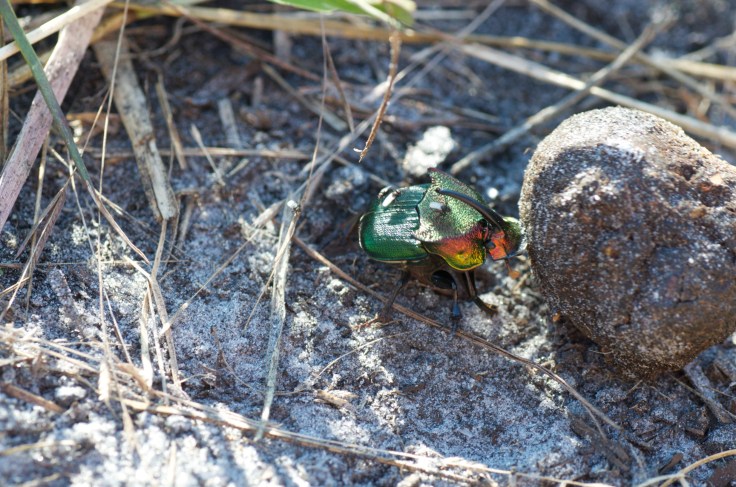
I was hiking around in my favorite place yesterday. (That’s Myakka River State Park for those who are infrequent readers of my blog. ) I was heading down All-Weather Rd. at a fairly good clip, intent on getting to a trail that I had not visited in some time. I’m not sure why I looked down but perhaps the angel on the shoulder of this Rainbow Scarab Dung Beetle cried out because my big right foot was heading right towards him. He would have been a goner and I would have been the one who was truly crushed to have injured or killed such an incredible creature.
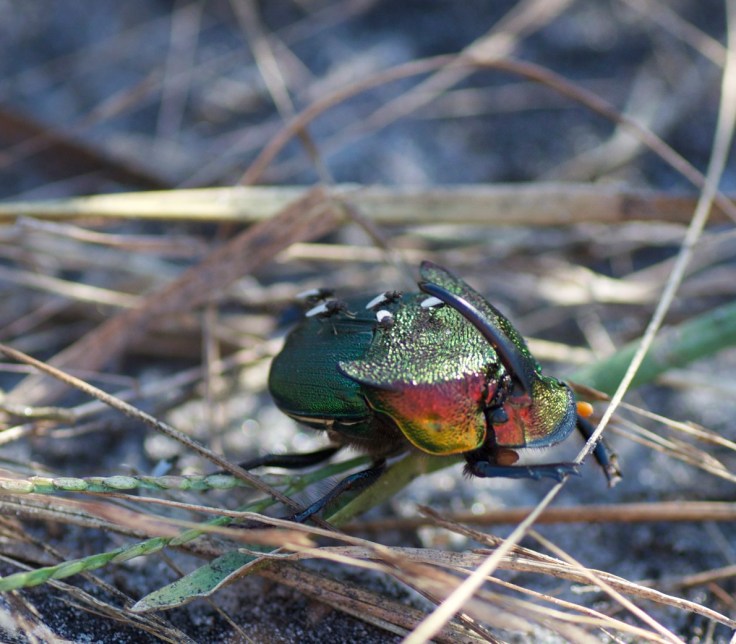
The Rainbow Scarab Dung Beetle is very aptly named. He does seem to have all the colors of the rainbow on him. He is certainly a scarab (the big horn and bright colors confirm that). And that is a big piece of dung that he is pushing around.
I quickly dropped my gear and got down to eye level with this critter. Have you ever seen such a thing? He certainly is the best dressed garbage collector I’ve ever seen. Dung beetles collect what most of us consider disgusting — excrement. They serve us all by collecting and using the dung of animals for food and as a repository for their eggs. In other words, they help make the dung go away. This one was a roller and I read that dung beetles can roll up to 10 times their weight. Other dung beetles pull their bounty and some are capable of pulling 1,141 times their own body weight: the equivalent of an average person pulling six double-decker buses full of people! What a creature! Humans have long been captivated by them. At least that’s what the reference sources say. There are even beetle dung derbies!
So, that’s what was happening at Myakka yesterday. Creatures going about their business, never realizing just how fantastic they are and never getting even a nod of recognition from most of us. So, I want everyone who reads this to look at this final dung beetle picture and say, with sincerity, “Thanks for cleaning up the s#!t.” You’ll feel better for having done so. 😉 ❧
Eco burns can be deeply disturbing. For most of us the idea of starting a fire to purposefully destroy the beauty of nature is troubling. But nature often depends on fire to renew. Long before there was man on the Myakka prairies there was lightening and through thousands of years the cycle of burning-renewal-burning constructed the unique landscape that is Myakka.
In her book, Myakka, Park Biologist Paula Benshoff has an excellent chapter called “Fire, Most Naturally.” She states that “the most intriguing and fascinating facet of my job is …involvement with fire ecology.”
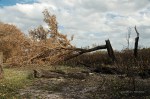
Oak tree that was felled by the burn. In the foreground is an old tree trunk that had served as a bench for many years.
Last March a prescribed burn was conducted between Fox’s High and Low Roads, one of my favorite hiking areas. It was a shock to emerge from the canopy of trees that leads from the parking area to the prairies. The burn was about two weeks old and everything was still very black and sooty. The old oak that had stood as a sentinel for many years was a victim of the burn. Its rotted mid-section could not hold. It came down hard. Another victim was the large tree trunk that had been there for many years and served as a useful bench.
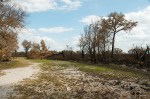
Fox’s High Rd. area was equally shocking. One reason I like this area so much is the easy access to different eco-systems. Fox’s High Rd. has sandy areas that make me think of our beautiful local beaches and there are pine trees dotting the landscape and framing several small meadow areas. I was worried that the pines would be gone. But they survived, a little singed, but still strong.
Fox’s High Road after prescribed burn.
As I poked through the charred landscape my worry and despair quickly gave way to wonder as I came across strong signs of new life.
Fresh growth two weeks after prescribed growth.The marsh off Fox’s Low Rd. looking back towards the road. This area is normally thick with vegetation and swampy but the drought had taken hold before the burn so there was plenty of dry vegetation for the fire..
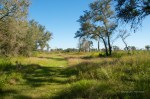
It is now autumn in Florida. There are some who will swear that Florida has no autumn. Accustomed to the dramatic colors of tall trees, newly arrived Florida residents have a hard time seeing our Florida Fall. But the season has been spectacular this year, especially in the burn areas. The grasses have roared back. They are tall, vigorous and bursting with different colors and shapes. Similarly the wildflowers seem more abundant and there seem to be more varieties.
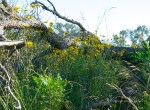
The old oak that stood for so many years on Fox’s Low Road is being given a beautiful salute. In this age where we celebrate life rather mourn the dead, the oak’s pyre of wildflowers and grasses seem gentle, supportive and most appropriate.
And along Fox’s High and Low Roads the views are wonderful. Check out the gallery pictures below for “before-and-after” shots. But most of all, Get Out There! Winter will be here all too soon and this glorious season of autumn in Florida will be gone. ❧
(For best results with gallery pictures, double-click on first image and then scroll through.)
Fox High Road
The marsh off Fox’s Low Rd. looking back towards the road. This area is normally thick with vegetation and swampy but the drought had taken hold before the burn.
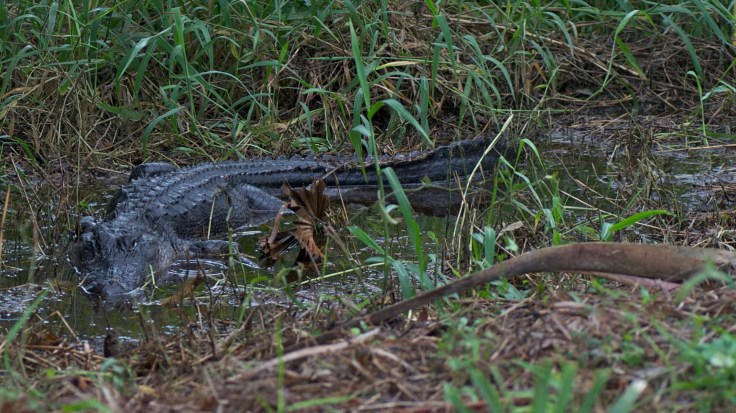
With the Myakka River running at flood stage alligators in Myakka River State Park are like kids let out for summer vacation. Throughout the late winter and spring months, alligators were forced into smaller and smaller areas in the Park. It was easy to spot them from the Park Drive bridge. One day last May I counted more than a dozen ‘gators visible from the bridge. They were all pushed into a small remnant of the River. But now! The school doors have opened and the alligators are everywhere! The Park is nothing but water and as you drive along the Park Drive you hear the ‘gators “talking” to each other — a strange snorting noise that those unfamiliar with alligators attribute to bullfrogs. But make no mistake, the ‘gators have courted and the rising waters have been as welcome as Levittown was to the returning soldiers of World War II. Nests are being made, eggs are being laid, and soon the Park will have many new ‘gators to amuse the tourists.
This handsome young gator was no more than three feet off the main drive in the Park.
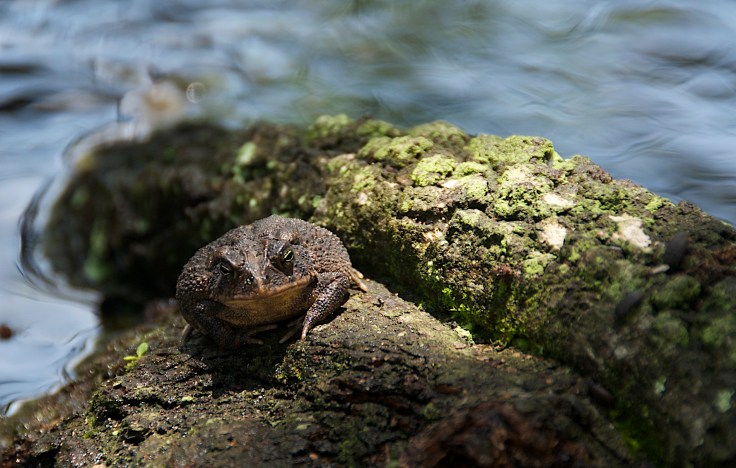
Myakka River is at flood stage and it is remarkably easy to launch the kayak. Drive to park, drive along Park Drive, stop and launch. The water is up to the road or over it. You can kayak through the trees and find some new surprises, like this frog from today.


 Trying to “capture a moment” is a lot like “saving time.” We frequently use these expressions but, honestly, neither can be done. The best we can hope for is the illusion of achievement. Photography is perhaps the best tool in this art of illusion. Pictures give us the sense of freezing moments in time and their evocative nature often succeeds in transporting us back in our memories and resurrecting “that feeling.”











 Alice's WanderLand