Image #95 – “If a tree falls in a forest …. “

“If a tree falls in a forest and no one is present to hear it, does it make a sound?”  — or something like that.  It is a phrase I first recall hearing when I was in college. Some kind of existential, metaphysical stuff.  Forgive me, I’m not good with this. Of course it makes a sound! How endeared we humans are with the concept that our own existence makes the sound…our experiencing the moment makes it be.  Pish posh.

When the tree that was once attached to this stump fell in the forest that is now the Joyce Kilmer Memorial Forest it made a sound. I am very sure of that.☙

Image #95

Image #94 – Joyce Kilmer Memorial Forest

Image #94(a)

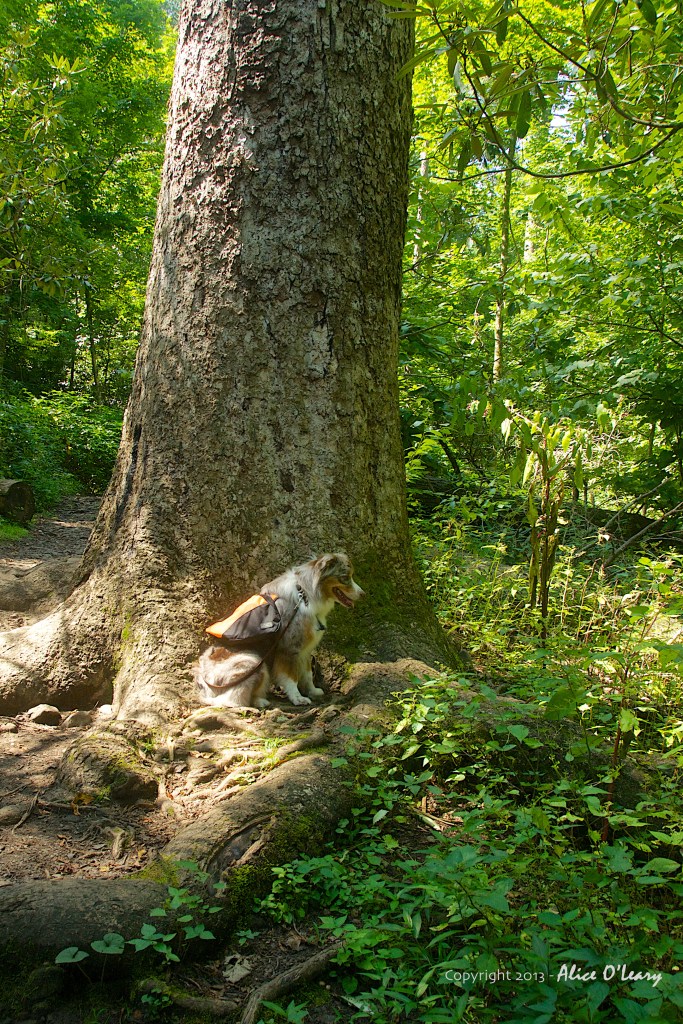
“I think that I shall never see/A poem as lovely as a tree”.  They are verses from my childhood.  The poetry of Joyce Kilmer, or at least his poem “Trees”, was a mainstay of my youth. Last week I had the good fortune to visit a forest that is named in his honor. The Joyce Kilmer Memorial Forest is tucked away in the very corner of western North Carolina. It has some of the last virgin forest growth on the east coast.

It is, simply, magnificent.

From the website:

A walk through Joyce Kilmer Memorial Forest is a journey back in time through a magnificent forest with towering trees as old as 400 years. Some enormous yellow-poplars are over 20 feet in circumference and stand 100 feet tall. The floor is carpeted with a garden of wildflowers, ferns, and moss-covered logs from fallen giants.

The only way to see the impressive memorial forest is on foot. The figure-eight Joyce Kilmer National Recreation Trail covers 2 miles and has two loops: the 1¼-mile lower loop passes the Joyce Kilmer Memorial plaque, and the upper ¾-mile loop swings through Poplar Cove, a grove of the largest trees. 

We enjoyed the full two-mile hike and look forward to returning. It is the kind of place that will never be the same, no matter how often you visit. Even Tango was amazed.  Image #94

For the next couple of blogs I will share images from the Kilmer Forest. Not all of its wonders are gigantic. Many are small and captivating.  All are wonderful.☙

Image #93 – Apples! We Had ’em…

Image #93

Frequent readers may recall that Fawn Hill came with a small orchard of apple trees and autumn is the time for apples.  Of course autumn doesn’t officially begin for another three weeks but apples don’t read calendars and the apples on Fawn Hill are ripe and ready to go.  We never expected much in this first year. The trees, like the rest of the property, have been neglected. We provided a pruning in May and wondered what might happen.

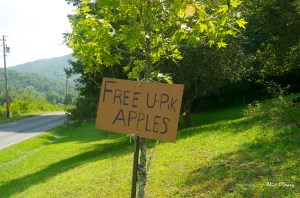
Well, as you can see, we had a bumper crop of apples. Perhaps it was the wet spring and summer that contributed. Maybe it was a favorable response to the pruning. We’ll never know. I do know there were way more apples than I could ever consume. My neighbor suggested I put up a sign, offering the apples for free. “People appreciate that kind of stuff around here.”

So, I did. I put up the sign yesterday afternoon and almost immediately saw the cars slow to Image #93(a)read the sign and assess the situation. Late this afternoon the crowds came … well, eight people is a crowd to me.  The three older apple pickers came prepared with buckets and had pretty much picked clean the lower branches when the other five arrived. They were much younger and of hispanic origin. It was clearly their first time picking apples and they were thrilled. I went down to visit and learned where they live (very nearby). They were appreciative of the apples and were going to try to bake a pie.  I suggested they might want to start with apple sauce. This was a GREAT idea. They asked how to make apple sauce and I gave them a quick explanation. “Look it up on online,” I said. You would have thought I’d given them the key to the universe.

By twilight the trees were picked clean … well, clean enough to take down the sign and re-assess the situation. My young neighbors climbed part way into the trees and shook loose many apples.  It was fun to watch but I worried for the health of the trees and the youngsters up in them.  One tree has many apples but they aren’t healthy. An aggressive pruning is in order next spring. It may be that the tree has reached the end of its run.  But the others are clearly healthy and capable of producing a good crop. We’ll see what next year brings. ☙

Image #91 – Toadstools

Image #91

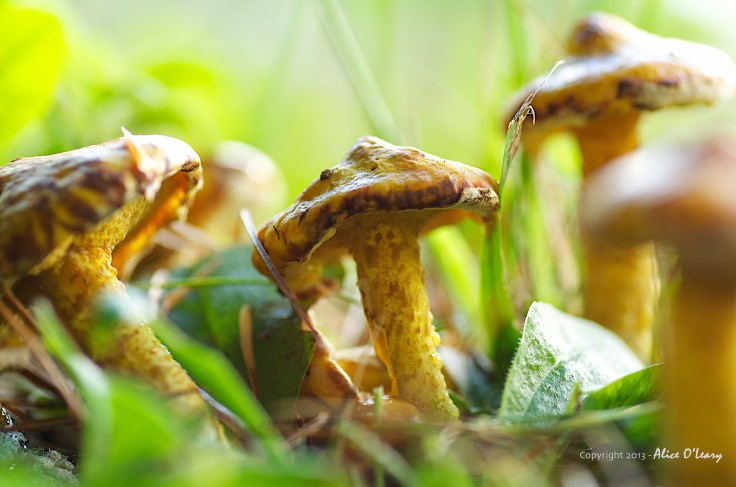
Toadstool.  What a wonderful word. It conjures so many images, it tweaks the imagination, it brings a smile to one’s face.  So, what is the difference between a mushroom and a toadstool? Most internet sites that I visited said there were none although there is a widespread belief that toadstools are poisonous and mushrooms are not.  According to one site the earliest reference to “toadstools” is from the 1400s.  To me it’s about the look.   Some mushrooms are toadstools.  Like these.  These are definitely toadstools. ☙

Image #90 – On the brink …

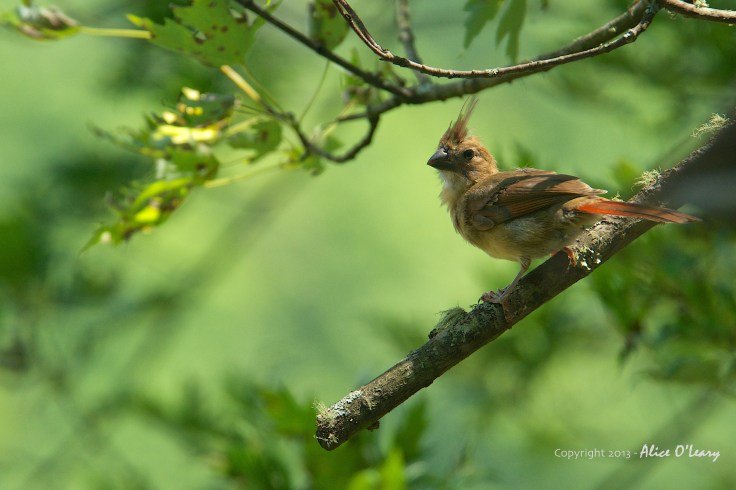
Image #90It has been a joy to watch fledglings mature to almost adulthood. This picture is a perfect example.  A juvenile, female red cardinal, I’ve watched her parents fly in and out of the feeders on an endless gravy train run of food to their chicks. Later the parents brought the young birds to the feeders where I would watch tender feedings from adults to fledglings.  Soon the parents made it clear it was time for the young ones to stand on their own and so they have.  This young female is poised on the brink of adulthood. Perhaps she’ll join a migration southward or maybe cardinals “tough it out” in the North Carolina winter. I haven’t been here long enough to know and, since I don’t plan to be here in the winter, I’ll probably never know.  We can’t know the minutiae of life’s cycle, only the broad strokes.  She is vibrant and ready to take on life.  Good luck to her. ☙

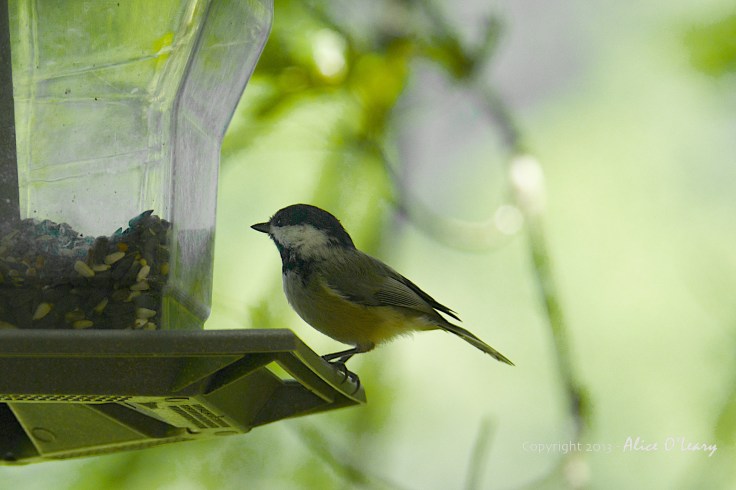
Image #89 – A simple Chickadee

Image #89Tonight’s post is a simple chickadee, grabbing some chow at the feeder. Birds, if you watch them long enough, take on human qualities.  There are the flashy birds–like hummingbirds, cardinals, and buntings. There are the working class birds–the finches, doves and crows. And then there are the not-quite-flashy-but -fun birds–like the chickadee, the tufted titmouse … so many birds!  I love them all, even the drab LBJs–little brown jobbers. My late friend Susan was the first person I heard use that expression. It stuck like glue. There are TONS of LBJs–finches, sparrows, juvenile _________________ (fill in the blank). With age I have come to realize that appreciation is the key, not the species name.  Chickadees or LBJs, I love them all. ☙

Image #88 – The Swarm

Image #88Autumn is close at hand. Migrations and changes have begun. Yesterday a neighbor called to ask if I was being over-run by starlings. Her deck, with its many feeders, was covered with starlings–young, adult, old, they all vied to get as much feed as they could before flying away. Birds migrate mostly at night, using the stars for navigation. So these starlings were “packing on the carbs” before the night’s flight.

A few starlings visited me but my swarm was quite different. It was bees!  Hundreds of bees had found their way to my hummingbird feeder and drained it dry. There were so many bees that the birds were intimidated and perhaps even stung. They would fly in, furtively, grab a quick mouth of seed and fly away with bees on their tails.  The bees massed in great numbers on the hummingbird feeder and some even climbed into the feeder through a feeding hole that had lost its tiny plastic “flower” which narrows down the opening, drowning themselves in the process and making quite a mess.  You can see them in this picture, bunched at the top of the liquid.

I was puzzled as to why they had suddenly decided to descend on a feeder that has been in place for two months. The answer presented itself today.

A short distance from the hill on which I live is a small business that specializes in erosion control and surveying properties. The owner also has bee hives which he put out in a field last May during my visit. In the past couple of days the number of beehives has increased dramatically and so has the activity at the business during the night. The annoying beep-beep-beep of a lift backing up has pierced the night, disrupting the sleep for many of us here on Fawn Hill. We could not imagine what this company was doing in its work from 10 p.m. to 3 a.m. but today, as we drove by the place returning from a delightful day trip to the Joyce Kilmer Memorial Forest we noticed that the number of hives has increased tremendously. They line the driveway and stretch onto the fields. Suddenly it all became clear. The bee hive keeper was collecting his flock, preparing it for a move south. Hence the bee population in this neighborhood has skyrocketed and they are going for whatever they can find eat.

Just another part of the cycle. I’ve been told I need a special feeder that has holes so small that only hummingbirds with their small proboscis can access them. I’ll make that investment and, next year, the hummers will have two feeders until the bees return in August. Then we’ll put away the feeder that calls many to their death.  Just part of the learning process here on Fawn Hill and, after all, life is for learning. ☙

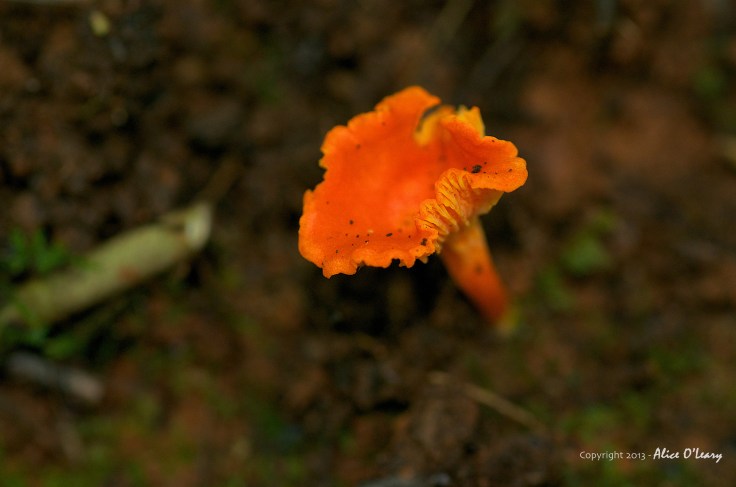
Image #87 – Cinnabar-red Chanterelle?

Image #87Backyard naturalists everywhere agonize over the process of identifying their sightings. It would seem that capturing an image of something–flower, bird, tree, mushroom–would make identification easy but it doesn’t. This beauty (above), making a second appearance in this blog (see “Tonight, Under the Big Top“), had me stumped for a while. But I think it is a chanterelle. Yesterday’s image did not reveal the classic trumpet shape that chanterelles adopt. This mushroom is standing nearby the first and clearly has the chanterelle trumpet shape developing.

One can argue, “Who cares?”  Post the picture and move on. Given my inability to retain very many names of the natural wonders around us I can almost go in that direction. Post the picture and move on.  But these wonders are just that…wonders.  And it seems …respectful to at least make a stab at getting the name right. I encourage, and even welcome, confirmation or correction. ☙

Image #86 — And tonight, under the big top …

Image #86

Macro photography is a wonderful hobby.  But it is also … well, it is hard work.  Today I was doing some work in the backyard when my eye caught the most amazing bright orange color under brown, damp leaves. There were two small orange  dots and I began to carefully clear away the detritus wondering what would emerge. To my utter amazement there were two, very small mushrooms.  One was about two inches tall, the other about half that size.  The color was stupendous.  They were ORANGE!!!!!!!!!!!!!!!  They bordered on red.  To say I was captivated is an understatement.

I dropped everything I was doing and headed to the house for the camera and attendant gear — tripod, remote shutter release, etc. But these small lovelies were on a steep slope…a slope I was trying to preserve by re-building a beautifully stacked stone wall.  And they are so small. The one above in no more than an inch in height. A nearby cousin is about 1.5 inches.  The equipment that I was bringing to capture these beings could easily crush either one and the slope made arranging the tripod VERY difficult.

I struggled with the situation for the better part of an hour, snapping about 50 or so images.  There are, perhaps, two to three that I am happy with but I have learned that I am too harsh on myself. Many images that I deem “adequate” are viewed by others as “fabulous.”  And I have begun to understand why. Even though my photos may not be up to National Geographic standards the simple truth is that I pause to capture moments that make others appreciate what is out there, around them, thriving on this globe that we call home … Earth.

And, from a purely selfish point-of-view, macro photography reveals wonders that none of us are aware of. This shot is a perfect example. My energy was focused on trying to capture a photo of this less-than-one-inch-high mushroom. The focus is less than satisfactory but look…to the right…dropping from the mushroom like a player in some Cirque de Soleil show at Las Vegas or Disney World.  I did not see that creature until I off-loaded the pictures to my computer.  It personifies what I love about macro…the absolute unknown, captured in a shutter’s heart beat. None of the other pictures had this creature. Macro, to my mind, is a WHOLE lot of preparation but also a WHOLE lot of luck.  This is not a particularly good picture but it has captured a life energy that 99% of us are totally unaware of.  How cool is that? How wonderful is it that we can capture these moments?

Macro rocks!☙

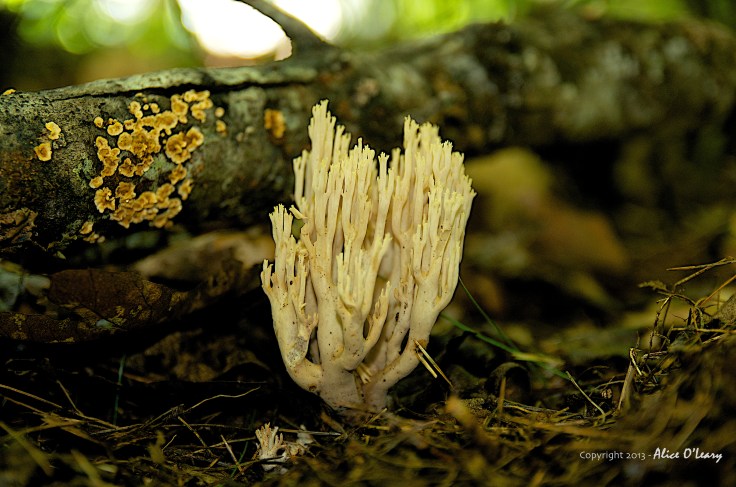
Image #85 – Coral Mushrooms

Image 85

A week of rain has brought another round of mushrooms popping up in the Carolina woods.  Many are familiar from last July but a newcomer (to me) is a good sized stand of Straight-branched Coral mushrooms near our tool shed.  Larger than the Violet-branched Coral mushroom of a few weeks back, these mushrooms seem very robust. It will be interesting to see if they become food for some critter. The field guide states they are “sometimes bitter.” I accepted that and let them be. ☙

Image 85(a)

Blog at WordPress.com.

Up ↑