
I don’t think I will ever tire of hummingbirds. ❧
A multi-media account of my travels through life

I don’t think I will ever tire of hummingbirds. ❧


We’ve had torrential rains today and my feeders almost seem to groan under the weight of scores of hungry, soggy birds. This poor Red Cardinal seems at the end of his rope. I hope his energy was revived by the feed. ❧

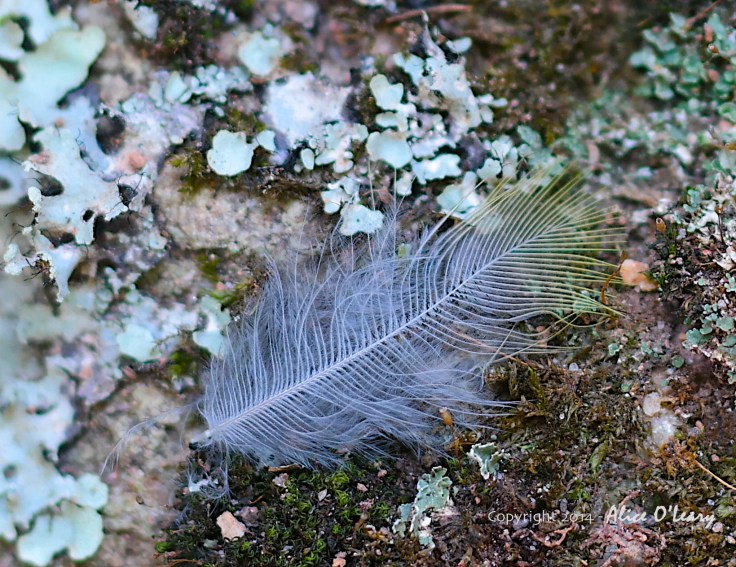
This feather, likely from an American Goldfinch fledgling, was shed by its owner, drifted in the breeze, and came to rest on one of the rocks of our stone wall.
About 1″ in length, it was not exactly flashing neon to get noticed. But that little yellow tip caught my eye.
It rests on the wall lichen which is probably 15 years of age.
Just a moment from Fawn Hill… ❧


The Indigo Buntings are regular visitors to my feeder these days. My neighbor reports seeing them in previous years but my experience on Fawn Hill is short, just over one year, and I’m certain I did not see them last year. These birds are memorable once you see them. But they are very shy and wary of humans. No doubt they were once coveted for those beautiful feathers. Hat fashion in the early 1900s was a catastrophe for so many beautifully plumed birds.
Cool facts about Indigo Buntings (courtesy of The Cornell Lab of Ornithology): Indigo Buntings fly about 1,200 miles each way between breeding grounds in eastern North America and wintering areas from southern Florida to northern South America and Cuba.
Indigo Buntings migrate at night, using the stars for guidance. Researchers demonstrated this process in the late 1960s by studying captive Indigo Buntings in a planetarium and then under the natural night sky. The birds possess an internal clock that enables them to continually adjust their angle of orientation to a star—even as that star moves through the night sky.


I was stung by a bee yesterday. The hot, itchy welt on my arm will remind me of that little guy for a few days. I decided to search my photo library for shots of bees and came up with quite a few so I made this collage.
Say the word “bee” and most of us think of big, fat bumble bees. There are many kinds of bees (20,000 according to one website) and they are related to wasps. I don’t really know which got me yesterday (bee or wasp) because it was rather small but it had a big punch. It left no stinger which leads me to believe it was a wasp. Regardless, they are all critical to our well being. Especially bees who, as we know, are the pollinators of the planet. Oh sure, we smart humans have learned how to pollinate plants but, honestly, the bees do it better and don’t cost as much as Monsanto. So, let’s all do what we can for the bees because, as “Vanishing of the Bees” has taught us, they are in serious trouble. And if one stings you get away from the area because once a bee or wasp stings something it releases a pheromone that tells other bees to come quick and sting the interlopers. You’re the interloper. Tell it you are sorry and get out of their town. 🙂


Having dominion over the land and sea is not an easy task and recent history will call to question whether we are doing a good job of things. As for me, I do my best to keep things in order here on my little acre on Fawn Hill. Today that included trimming dead branches and leaves from the apple trees. The late frost of last April took its toll but, fortunately, not all the fruit. This year’s bounty will be no where near last year’s but there will still be plenty. There is evidence the deer are already enjoying the fruit of my apple trees. I’m glad. ❧


A soggy hummingbird gives me the eye during our two days of constant rain. Thankfully it was constant and not torrential but it was seriously constant and it made it tough for our friends who live in trees. Where do they go when night falls? Certainly some are minding nests and protecting young ones. Last night must have been a long one because the rain did not cease. First order of business when the rain stopped? Off to Tractor Supply for more birdseed, of course. ❧


It has been a wet day here in Western North Carolina. Wet and cool. Natives are already predicting a long, cold winter. But for the moment it is still summer and there are baby birds to feed. Today my feeder was like a drive-thru at a fast-food restaurant. At one point I counted eight cardinals gathered round the feeders. Some of the males flew in to frighten the poor house finches who look so miserable in weather like this. Once the finches were gone the cardinals fed peacefully in some pre-ordained order. Who knows how all these things work.
The hummingbirds have also been in and out all day. That’s one of them in the picture. Notice the raindrop on his head. Hummingbirds rarely feed at the same time. They must have “little bird syndrome” because they are quick to drive away the other hummers. I suppose they each get enough. There were at least three today and I spent so much time observing them that I began to notice the traits and slightly different coloring.
There were at least 13 species of bird at my feeders today. It was a good day, despite the weather ❧


My previous post (Image #258 – Indian Pipe Emerging) prompted a good friend to send me an email that said, in part,
Your image reminded me of a crocus, while some of the other images on the net looked so much like fungi I could hardly believe they were plants. What a wonderful world this is, filled with so many remarkable and beautiful things for those who have eyes to see. Getting the big picture is important, but you will never get the big picture if you don’t also study the small things.
Indian Pipes are sometimes called “Ghost” or “Corpse” plant because of its remarkable lack of color or, more accurately, chlorophyll. According to Wikipedia:
Instead of generating energy from sunlight, it is parasitic, more specifically a myco-heterotroph. Its hosts are certain fungi that are mycorrhizal with trees, meaning it ultimately gets its energy from photosynthetic trees. Since it is not dependent on sunlight to grow, it can grow in very dark environments as in the understory of dense forest. It is often associated with beech trees. The complex relationship that allows this plant to grow also makes propagation difficult.

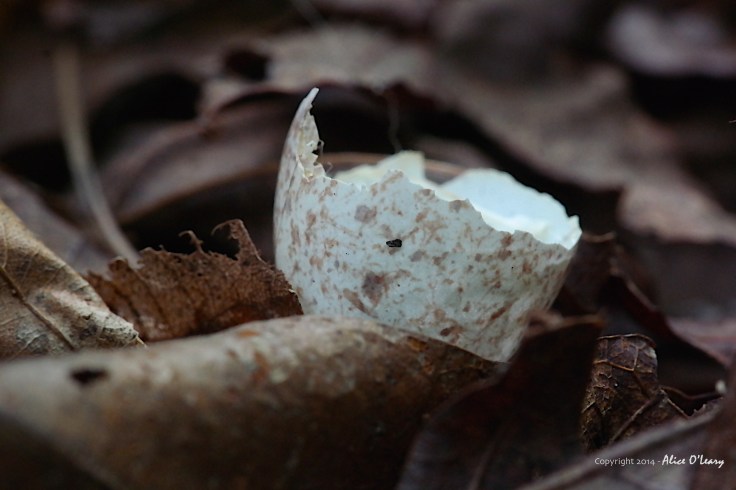
A successful birthing? It would seem that way. The small remains of a bird’s egg graces the forest floor. Live long! Prosper! ❧
 Alice's WanderLand