Image #271 – Wood Asters with raindrops

Image #271


Asters are so plentiful and so sturdy.  Little blasts of color as the days start to change from summer to fall.  The name Aster comes from the Ancient Greek word ἀστήρ (astér), meaning “star”, referring to the shape of the flower head.  These wood asters are a gift from friends. We planted them along the side of the house last October and I feared they would not survive the winter but they have returned and are quite robust.  We are barreling toward the autumnal equinox and change is already in the air. ❧

Image #270 – Fawn Hill’s Wildflowers

Side Hill Flower


This is my second summer at Fawn Hill. It’s an abbreviated one because of my Western travels last Spring and the Florida election this Fall. I will head back to Florida on September 5 and begin campaigning for Amendment 2, the medical marijuana initiative.

But even with an abbreviated stay of  about 12 weeks it has been a lovely time. The house has moved beyond the phase of everything seeming critical.  There are still plenty of fixer-upper things to do but last year’s sense of urgency is gone. More importantly, the hard work of last year has begun to pay.  The front side hill is a perfect example.  When we first arrived it was terribly overgrown with brambles and no small amount of poison ivy. It required most of last summer to eradicate both of those scourges.  But having cleaned out the mess I was then confronted with what to do with the space.  There were still plenty of things to do and so I let it slide.  When I arrived back in June of this year the wildflowers had begun to take over and I decided to let things go. It was the wait-and-see approach and it has been fun.

The center of the collage is an overall picture of what I currently have, a swatch of wildflowers. The always reliable Queen Anne’s Lace is a dominant player but there are others.  In the upper right is a close-up of what I now know is Punctureweed.  I have lots of it and have learned it is a scourge to grass eating creatures such as cows.  But the bees absolutely adore it and can’t seem to move fast enough to get every last bloom. Below that is a Butterfly Pea, a sweet little thing. The red Coreopsis, I confess, was bought and planted by me. I hope it lives long and prospers. I love the color. The last is Purple Milkwort and, as you can see, the bees like it also.

Next year I will help the area with some wildflower seed and perhaps some Cosmos seeds.  The area is so steep it is impossible to maintain anything too demanding. Wildflowers only demand the space to grow.  ❧

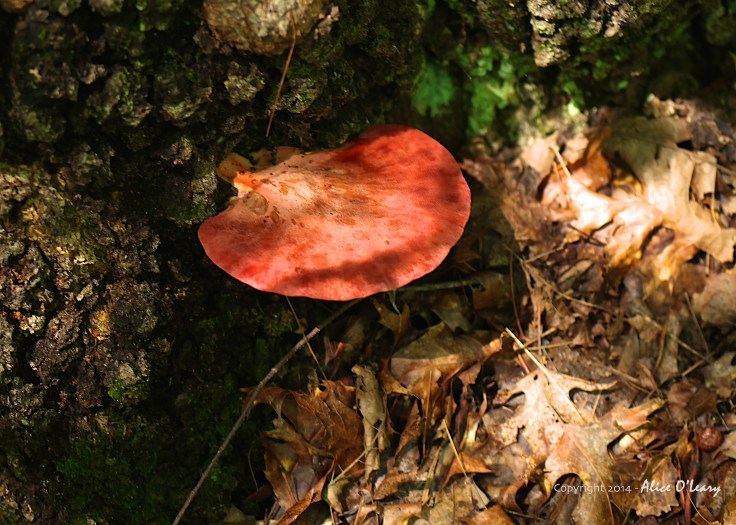
Image #269 – Beefsteak Fungi! Who knew?

Beefsteak Fungi

This spectacular fungus emerged at the base of an oak tree on Fawn Hill and one of my reference books tells me this fungi is responsible “for making old oaks hollow.”  Its color was absolutely stunning and it is quite large, about 6 inches across.   ❧

Image #268 – Chanterelle

Chanterelle

Chanterelle mushrooms on Fawn Hill. ❧

Image #267 – Hummingbird on wing

Image #267

I don’t think I will ever tire of hummingbirds.  ❧

Image #266 – Some Days Are Just Hard ….

Image #266

We’ve had torrential rains today and my feeders almost seem to groan under the weight of scores of hungry, soggy birds.  This poor Red Cardinal seems at the end of his rope. I hope his energy was revived by the feed. ❧

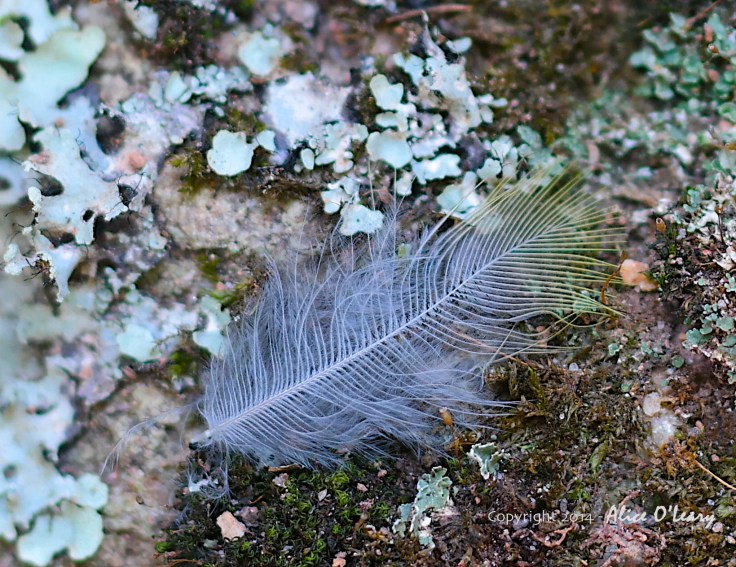
Image #265 – The New Meets the Old

Image #265

This feather, likely from an American Goldfinch fledgling,  was shed by its owner, drifted in the breeze, and came to rest on one of the rocks of our stone wall.

About 1″ in length, it was not exactly flashing neon to get noticed. But that little yellow tip caught my eye.

It rests on the wall lichen which is probably 15 years of age.

Just a moment from Fawn Hill… ❧

Image #264 – Indigo Bunting (Passerina cyanea)

Image #264

The Indigo Buntings are regular visitors to my feeder these days. My neighbor reports seeing them in previous years but my experience on Fawn Hill is short, just over one year, and I’m certain I did not see them last year. These birds are memorable once you see them. But they are very shy and wary of humans. No doubt they were once coveted for those beautiful feathers. Hat fashion in the early 1900s was a catastrophe for so many beautifully plumed birds.

Cool facts about Indigo Buntings (courtesy of The Cornell Lab of Ornithology): Indigo Buntings fly about 1,200 miles each way between breeding grounds in eastern North America and wintering areas from southern Florida to northern South America and Cuba.

Indigo Buntings migrate at night, using the stars for guidance. Researchers demonstrated this process in the late 1960s by studying captive Indigo Buntings in a planetarium and then under the natural night sky. The birds possess an internal clock that enables them to continually adjust their angle of orientation to a star—even as that star moves through the night sky.


Image #263 – Bees

Bee Collage


I was stung by a bee yesterday. The hot, itchy welt on my arm will remind me of that little guy for a few days.  I decided to search my photo library for shots of bees and came up with quite a few so I made this collage.

Say the word “bee” and most of us think of big, fat bumble bees. There are many kinds of bees (20,000 according to one website)  and they are related to wasps. I don’t really know which got me yesterday (bee or wasp) because it was rather small but it had a big punch. It left no stinger which leads me to believe it was a wasp.  Regardless, they are all critical to our well being. Especially bees who, as we know, are the pollinators of the planet.  Oh sure, we smart humans have learned how to pollinate plants but, honestly, the bees do it better and don’t cost as much as Monsanto. So, let’s all do what we can for the bees because, as “Vanishing of the Bees”  has taught us, they are in serious trouble.  And if one stings you get away from the area because once a bee or wasp stings something it releases a pheromone that tells other bees to come quick and sting the interlopers.  You’re the interloper. Tell it you are sorry and get out of their town.  🙂

Image #262 – Stewards of the Land

Image #262


Having dominion over the land and sea is not an easy task and recent history will call to question whether we are doing a good job of things. As for me, I do my best to keep things in order here on my little acre on Fawn Hill. Today that included trimming dead branches and leaves from the apple trees. The late frost of last April took its toll but, fortunately, not all the fruit. This year’s bounty will be no where near last year’s but there will still be plenty. There is evidence the deer are already enjoying the fruit of my apple trees.  I’m glad.  ❧

Blog at WordPress.com.

Up ↑